Dental Implant Treatment in Vrindavan Yojana, Lucknow
Dental Implant Treatment in Vrindavan Yojana, Lucknow
A missing tooth can change the way you eat long before it noticeably changes your smile. You may start chewing on the opposite side, avoiding certain foods, or feeling an unfamiliar gap with your tongue. If you’re exploring dental implant treatment in Vrindavan Yojana, Lucknow, understanding how implants replace missing teeth can help you decide whether they are suitable for your dental needs.
When a tooth is lost, the surrounding bone gradually begins to change because it no longer receives the same stimulation from the tooth root. Neighboring teeth may also shift toward the empty space over time, sometimes affecting the way your upper and lower teeth meet.
Dental implants replace missing teeth using artificial tooth roots placed inside the jawbone. At SmyleXL Dental Clinic, implant treatment planning considers the number of missing teeth, jawbone condition, gum health, and individual oral health requirements.
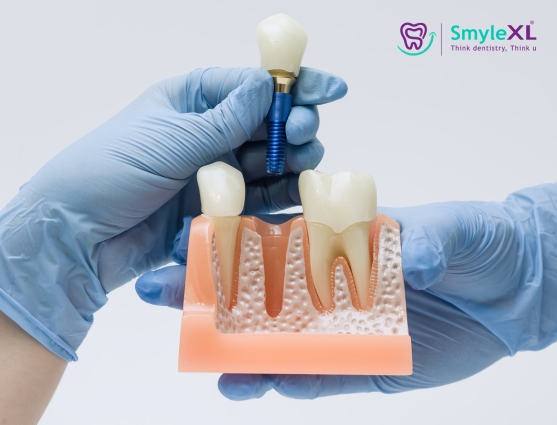
Dental implant treatment is a procedure used to replace missing teeth with artificial roots that support dental crowns, bridges, or fixed dentures. An implant is usually made from titanium or another suitable material and is placed into the jawbone to provide a stable foundation for replacement teeth.
A dental implant restoration generally consists of three main components:
Over time, the surrounding bone grows into close contact with the implant surface through a process called osseointegration. This helps the implant become stable enough to support the final restoration.
A single implant supports a replacement crown when one tooth is missing. It allows the gap to be restored without preparing neighboring healthy teeth for a conventional dental bridge.
When several teeth are missing, multiple implants may support individual crowns or an implant-supported bridge. The number required depends on the location and size of the gap.
All-on-4 treatment uses four strategically placed implants to support a full-arch fixed dental restoration. It may be considered for selected patients who have lost most or all teeth in one jaw.
All-on-6 treatment uses six implants to support a full-arch restoration. The additional implants may help distribute chewing forces across more supporting points, depending on the jawbone and restoration design.
The appropriate option depends on the number of missing teeth, available bone, bite, and overall oral health.
Dental implants may be considered when one or more teeth are missing or cannot be preserved through appropriate dental treatment. The decision depends on oral health, bone support, and the available tooth replacement options.
Common situations include:
Dental implants are not necessary or suitable for every missing tooth. A dental examination helps determine whether implants, bridges, or dentures are appropriate.
Dental implants provide a fixed foundation for replacement teeth and can improve chewing, appearance, and everyday oral function.
1. Replaces Missing Teeth
Implants support artificial teeth that help restore gaps caused by tooth loss.
2. Improves Chewing Ability
A stable implant-supported restoration can make chewing more comfortable and allow patients to eat a wider variety of foods.
3. Helps Preserve Jawbone
Implants transfer some chewing forces to the jawbone, which can help reduce bone loss around the implant site compared with leaving the area without a tooth root.
4. Maintains Neighboring Teeth
A single-tooth implant generally does not require reshaping adjacent healthy teeth to support the replacement crown.
5. Provides Stable Tooth Replacement
Implant-supported restorations remain attached during everyday activities, reducing the movement associated with some removable dentures.
6. Supports Long-Term Oral Function
With good oral hygiene, suitable bone support, and regular maintenance, dental implants can remain functional for many years.
Dental implant treatment is an established tooth replacement procedure, although healing and long-term results depend on several individual factors.
Some considerations include:
Careful treatment planning, appropriate healing, good oral hygiene, and regular dental examinations help reduce avoidable complications.
Dental implant treatment involves examining the mouth, planning implant placement, inserting the artificial root into the jawbone, allowing healing, and attaching the final replacement tooth.
The procedure generally takes place over multiple appointments, particularly when the implant requires several months to integrate with the surrounding bone.
Step 1: Dental Examination
The dentist examines the missing tooth area, neighboring teeth, gums, and bite. Dental X-rays or a CBCT scan may be recommended to assess bone height, width, and surrounding structures.
Step 2: Implant Treatment Planning
The number, size, and position of implants are planned according to the available bone and the type of replacement teeth required.
If gum disease, infection, or insufficient bone is identified, additional treatment may be necessary before implant placement.
Step 3: Implant Placement
The implant fixture is placed into the jawbone through a carefully prepared opening. The surrounding gum tissue is then managed according to the surgical approach.
Step 4: Healing and Bone Integration
The implant is allowed to heal as the bone forms a stable connection with its surface.
Healing time varies depending on the implant site, bone quality, and individual health conditions.
Step 5: Attaching the Abutment
Once adequate stability is achieved, the connecting component is attached to the implant. Impressions or digital scans may be taken to prepare the replacement crown or other restoration.
Step 6: Placing the Final Restoration
The finished crown, bridge, or full-arch restoration is secured to the implant components. The dentist checks its fit, appearance, and bite.
Step 7: Follow-Up and Maintenance
Patients receive instructions about cleaning around implants, eating during recovery, and attending follow-up appointments.
Regular maintenance helps monitor the implant, surrounding gums, and attached restoration.
The cost of dental implant in Vrindavan Yojana, Lucknow ranges from ₹25,000 to ₹50,000 per tooth, depending on the implant system, jawbone condition, restoration requirements, and treatment complexity.
Replacing several missing teeth or restoring a complete dental arch involves different treatment plans and higher overall expenses.
Implant Treatment | Approximate Cost |
Single Tooth Implant | ₹25,000–₹50,000 |
Multiple Dental Implants | ₹50,000–₹1,50,000 |
All-on-4 Dental Implants | ₹2,50,000–₹4,00,000 |
All-on-6 Dental Implants | ₹3,50,000–₹6,00,000 |
These are indicative treatment ranges. The total cost depends on the number of implants, restoration design, and individual clinical requirements. Full-arch estimates should be confirmed for the specific arch and treatment package.
Replacing a single tooth generally involves a different expense from placing several implants or supporting a complete set of teeth.
Implant systems differ in materials, component design, and manufacturing requirements. The selected system can influence the overall price.
Adequate bone is necessary to support an implant. Patients with reduced bone volume may require grafting or other preparatory procedures.
Individual crowns, implant-supported bridges, and full-arch restorations differ in materials, design, and fabrication requirements.
Gum disease treatment, tooth extractions, bone grafting, or additional imaging may increase the total treatment expense.
Depending on the selected treatment package, charges may include:
The exact inclusions must be confirmed, particularly whether the quoted price covers only implant placement or the complete restoration with the abutment and crown.
Additional charges may apply for:
Not every patient requires these procedures. A detailed treatment estimate should identify the number of implants, restoration materials, included components, and any additional costs.
Disclaimer: The prices mentioned above are approximate and indicative. Actual costs may vary depending on the implant system, number of missing teeth, jawbone condition, restoration material, treatment complexity, and additional procedures required. A dental examination and appropriate imaging are necessary to determine the treatment plan and provide an accurate cost estimate.
SmyleXL Dental Clinic provides dental implant treatment with attention to tooth replacement planning, oral health, patient comfort, and clear communication about the procedure and expected expenses.
Experienced Dentists
The dentists assess missing teeth, jawbone support, gum health, and bite relationships before determining the implant treatment requirements. Specialist evaluation or referral may be recommended when appropriate.
5-Step Sterilization Protocol
The clinic follows a five-step sterilization protocol to support instrument hygiene and infection control during dental procedures.
Highly Ethical and Cost-Transparent Dentistry
Patients receive information about the proposed implant system, treatment stages, estimated costs, restoration requirements, and additional procedures that may be necessary.
Personalized Care in a Relaxing Environment
Treatment planning considers individual tooth replacement needs, oral health conditions, and patient comfort. The surgical, healing, and restoration stages are explained in understandable language.
A missing tooth can gradually affect chewing, neighboring tooth positions, and the supporting jawbone. Dental implants offer a way to replace missing teeth using stable artificial roots that support crowns, bridges, or full-arch restorations.
For people considering dental implant treatment in Vrindavan Yojana, Lucknow, understanding the available implant options, procedure, healing period, and expected costs can help make informed tooth replacement decisions.
Implants require consistent oral hygiene, healthy surrounding tissues, and regular dental maintenance. Consulting a dentist can help determine whether implant treatment is suitable or whether another tooth replacement option would be more appropriate.
1. What Age Is Best for Dental Implants?
Dental implants are generally considered after jaw growth is complete, usually in late adolescence or adulthood. There is no strict upper age limit, and suitability depends more on bone condition, oral health, and overall health than age alone.
2. How Painful Is Getting a Dental Implant?
Dental implant placement is usually performed with measures to control discomfort during the procedure. Mild soreness, swelling, or tenderness may occur afterward, but these symptoms commonly improve over several days.
3. How Long Does Dental Implant Treatment Take?
Dental implant treatment often takes several months because the implant needs time to integrate with the jawbone before the final restoration is placed. The duration depends on healing, bone condition, and whether additional procedures are required.
4. Can Dental Implants Last a Lifetime?
Dental implants can remain functional for many years and may last a lifetime in some patients, but this cannot be guaranteed. Their longevity depends on oral hygiene, gum health, implant maintenance, and individual risk factors.
5. Is a Dental Implant Better Than a Dental Bridge?
Dental implants replace missing teeth without usually requiring preparation of neighboring healthy teeth, while traditional bridges rely on adjacent teeth for support. The appropriate option depends on bone availability, condition of neighboring teeth, treatment requirements, and individual preferences.