
Here’s a situation nobody wants to be in: you had a root canal done, recovered, moved on with your life, and now, months or years later, that same tooth is causing trouble again. Pain, swelling, sensitivity that shouldn’t exist in a tooth that was supposed to be treated. It feels like a betrayal, honestly.
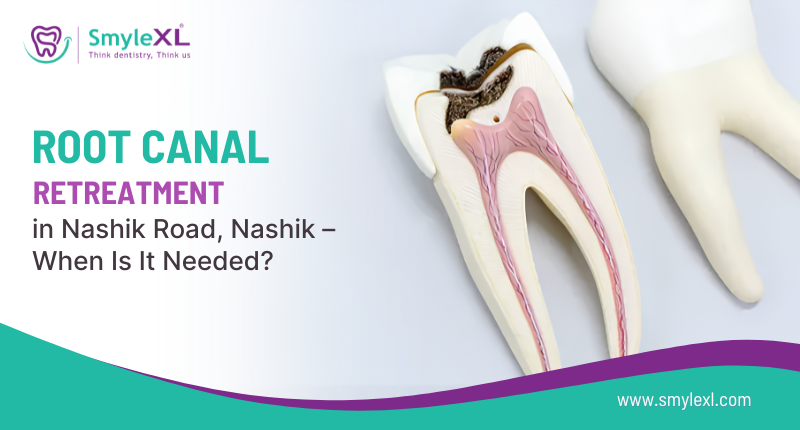
But here’s the thing: a root canal not working out the first time doesn’t mean the tooth is lost. Root canal retreatment in Nashik Road at SmyleXL Dental Clinic exists precisely for this situation. It’s not starting from scratch; it’s going back in with better information, better access, and a second chance at saving a tooth that’s worth keeping.
Here’s everything you need to know about when retreatment is needed, what it involves, and whether it’s the right call for your situation.
Table of Contents
ToggleWhy Would a Root Canal Fail?
A successfully treated root canal should last decades, often a lifetime. But sometimes things don’t go according to plan. Understanding why helps set realistic expectations for retreatment.
Missed Canals
Teeth, particularly molars, can have complex, branching canal systems. If a canal is missed or incompletely treated during the original endodontic retreatment procedure, bacteria remain inside the tooth and infection continues or returns.
Incomplete Sealing
The dental pulp re-infection care challenge doesn’t end with cleaning; the canals need to be sealed completely. If the filling material didn’t reach all the way to the root tip, or if it breaks down over time, bacteria find their way back in.
Delayed Crown Placement
A treated tooth without a crown is vulnerable. Cracks, microleakage, and recontamination through an unprotected tooth are among the most common reasons a tooth that was treated correctly still develops problems later.
New Decay
Recurring dental infection treatment is sometimes triggered by new decay reaching the root area, nothing to do with the original treatment, but everything to do with what’s happened since.
Complex Anatomy
Curved roots, calcified canals, or unusual root configurations make complete treatment challenging even for experienced clinicians. What wasn’t fully accessible the first time may be retreatable with better imaging and instruments.
Signs You Might Need Root Canal Retreatment
Tooth pain after the root canal that was treated, particularly pain that returns after a pain-free period, is the most common prompt. But the signs aren’t always dramatic:
- Tooth pain after root canal that never fully resolved, or returned months later
- Swelling or a pimple on the gum near the treated tooth
- Sensitivity to pressure or temperature in a tooth that shouldn’t have nerve sensation
- Darkening of the tooth
- A persistent bad taste near the tooth
- An X-ray showing a shadow at the root tip is a sign of ongoing infection even without obvious symptoms
Some failed root canal treatment cases are picked up during routine check-ups before any symptoms appear, which is exactly the kind of early detection that makes regular dental visits worth keeping. If you’ve had previous root canal work done and are due for a check-up, a visit to SmyleXL Dental Clinic for
root canal retreatment in Nashik Road starts with precisely this kind of thorough assessment.
Root Canal Retreatment vs. Extraction: Which Is Better?
This is the question most patients ask when they find out the original treatment hasn’t held. The honest answer: saving a previously treated tooth through retreatment is almost always preferable to extraction, especially when the tooth is restorable.
| Root Canal Retreatment | Extraction | |
| Preserves natural tooth | Yes | No |
| Long-term tooth preservation | High with proper restoration | Requires implant/bridge |
| Bone preservation | Yes | No, bone loss begins |
| Retreatment success rate | 75–85% | N/A |
| Timeline | Weeks | Months (for replacement) |
Retreatment success rate of 75–85% means most retreated teeth go on to function well for years. Extraction followed by implant placement costs more, takes longer, and involves additional surgery. For a tooth with healthy roots and adequate bone support, root canal retreatment in Nashik Road at SmyleXL Dental Clinic is the more conservative and cost-effective path, and for most patients, the outcome that makes the most long-term sense.
What Does the Retreatment Procedure Actually Involve?
Re-treatment of root canal follows a similar path to the original procedure, but with additional steps to address what went wrong the first time.
Step 1: Assessment and Imaging
A thorough examination and updated X-rays, sometimes a CBCT 3D scan, map the canal system precisely. This is where missed canals, incomplete sealing, or new infection are identified before treatment begins.
Step 2: Removing the Previous Filling
The crown or restoration is removed to access the tooth. The existing filling material, typically gutta-percha, is carefully removed from the canals using specialist instruments and sometimes ultrasonic technology.
Step 3: Cleaning and Reshaping
With the canals cleared, retreating an infected tooth involves thorough cleaning, reshaping, and disinfection, often going further and more precisely than the original treatment could. Missed canals are located and treated. Local anesthesia during retreatment ensures the process is comfortable throughout.
Step 4: Resealing and Restoration
The canals are refilled and sealed. A new crown or restoration is placed. This step is critical for long-term tooth preservation after retreatment.
The procedure typically takes 1–2 appointments depending on complexity. Post-retreatment recovery care involves mild soreness for a few days, which is manageable with prescribed medication.
Is Root Canal Retreatment Painful?
“Is root canal retreatment painful?” This is the question most patients type into Google at 11 pm before their appointment. The honest answer: no more than the original procedure.
Local anesthesia during retreatment numbs the area completely before anything begins. The tooth has no active nerve, so the discomfort during the procedure is minimal. Post-procedure soreness for 2–4 days is normal as the surrounding tissue responds to treatment. Pain relief after endodontic therapy is managed with standard medication and settles quickly for most patients.
For patients considering root canal retreatment in Nashik Road at SmyleXL Dental Clinic, this is worth knowing before that midnight Google spiral gets too deep: the anxiety about retreatment is almost always worse than the retreatment itself.
Risk of Repeated Root Canal: What to Know
Risk of repeated root canal is a real consideration. Each retreatment removes some tooth structure, and there are limits to how many times a tooth can be retreated before the structure is insufficient to support a restoration.
That said, second root canal on same tooth is entirely routine when done promptly and for the right clinical reasons. The risk increases with repeated retreatments, which is why addressing a failing root canal sooner rather than later keeps more options on the table.
SmyleXL Dental Clinic, Nashik Road: Retreatment Done Right
Root canal retreatment in Nashik Road at SmyleXL Dental Clinic begins with a thorough assessment: imaging, clinical examination, and an honest conversation about whether retreatment is the right path or whether extraction and replacement makes more clinical sense for your specific case.
Tooth saved after retreatment is the outcome most patients achieve when they act promptly and choose an experienced team. Nashik Road patients don’t need to travel far for endodontic specialist-level care; it’s available right here.
Book your consultation at SmyleXL Dental Clinic today, and find out whether your tooth is worth a second chance. It probably is.
Frequently Asked Questions
How do I know if my root canal has failed?
Key signs of failed root canal treatment include returning tooth pain after root canal treatment, swelling or a pimple on the gum near the tooth, persistent sensitivity, tooth darkening, or a bad taste that doesn’t resolve. Some failures are detected on X-rays during routine check-ups before symptoms appear, showing a shadow at the root tip indicating ongoing infection. Any of these signs warrant prompt assessment for re-treatment of root canal.
How long does root canal retreatment take?
The endodontic retreatment procedure typically takes 1–2 appointments depending on the complexity of the case, particularly how difficult the original filling material is to remove and whether missed canals need to be located and treated. Each appointment runs 60–90 minutes. Post-retreatment recovery care is straightforward: mild soreness for a few days, then back to normal.
Is retreatment better than extraction?
For most restorable teeth, yes. Saving a previously treated tooth through retreatment preserves natural tooth structure, maintains bone density, and avoids the time and cost of extraction followed by implant placement. A retreatment success rate of 75–85% means the majority of retreated teeth function well long-term. Extraction is the right call only when the tooth is no longer restorable; a clinical assessment determines which situation applies.
How many times can a tooth be retreated?
There’s no fixed number; it depends on how much tooth structure remains after each re-treatment of root canal and whether the root is still intact and functional. A second root canal on same tooth is entirely routine. Beyond that, each retreatment removes additional structure, and at some point the tooth can no longer support a restoration. Risk of repeated root canal is a genuine consideration, which is why addressing a failing root canal promptly keeps more options available.
What happens if root canal retreatment fails?
If recurring dental infection treatment through retreatment doesn’t resolve the problem, the next options are apicoectomy (a minor surgical procedure removing the root tip and surrounding infected tissue) or extraction followed by implant placement. Long-term tooth preservation is always the goal, but when retreatment and surgical options are exhausted, extraction with proper replacement is the right clinical decision. An honest assessment at SmyleXL Dental Clinic will always tell you clearly which situation you’re in.