
Dental implants restore more than a missing tooth. Once the implant-supported restoration is in place, keeping it clean helps maintain the surrounding gums and oral function. For patients undergoing dental implant treatment in Ahmednagar, knowing how to care for the restoration after treatment is just as important as the procedure itself.
Whether you have a single implant crown, implant-supported teeth, or a full-arch restoration, your daily cleaning routine should reach the areas around and beneath the restoration. At SmyleXL Dental Clinic, Ahmednagar, we can discuss implant care as part of your overall treatment and maintenance plan. This guide explains how to clean dental implants, which tools can help, and when you may need professional care over time.
Table of Contents
ToggleWhy Does Daily Cleaning Matter for Implant-Supported Teeth?
Implants are designed to integrate with the jawbone, but the surrounding soft tissues still need regular care. Plaque accumulation around an implant can irritate the gums and contribute to inflammation around the implant.
Good dental implant care therefore involves more than brushing the visible surfaces. Cleaning between teeth, around the gumline, and underneath accessible parts of the restoration helps control plaque and supports overall dental hygiene.
Your exact routine depends on your restoration, your oral health, and the design of your implant-supported prosthesis.
How to Clean Dental Implants Every Day
A consistent routine is the foundation of dental implant cleaning. The aim is to remove plaque without damaging the gums or restoration.
Brush Twice a Day
Use a soft-bristled toothbrush and fluoride toothpaste to clean the teeth, gumline, and accessible implant surfaces. Brush gently rather than applying excessive pressure, particularly around the gum tissue.
An electric toothbrush may also help some patients, but technique and consistent cleaning matter more than the brush type alone.
Clean Between the Teeth
Brushing cannot effectively clean every space between teeth. Floss, interdental brushes, or other recommended cleaning aids can help remove plaque from these areas.
When cleaning implant-supported teeth, the right tool may depend on the available space and the restoration’s design. Your dentist can advise which option fits your specific case.
Clean Around the Gumline
Pay attention to where the restoration meets the gum. Plaque can accumulate around this margin even when the visible tooth surface appears clean.
Gentle brushing along the gumline is an important part of how to clean dental implants and should be performed consistently rather than only when food becomes trapped.
How Do Cleaning Needs Differ for Different Implant Restorations?
Cleaning methods can change depending on the restoration and the number of implants supporting it.
Single Implant-Supported Tooth
Single implant crowns are generally straightforward to clean. Pay extra attention to the interdental areas (areas between the teeth). Clean the interdental areas, as they can lead to plaque buildup around the implant restoration.
Implant-Supported Dentures
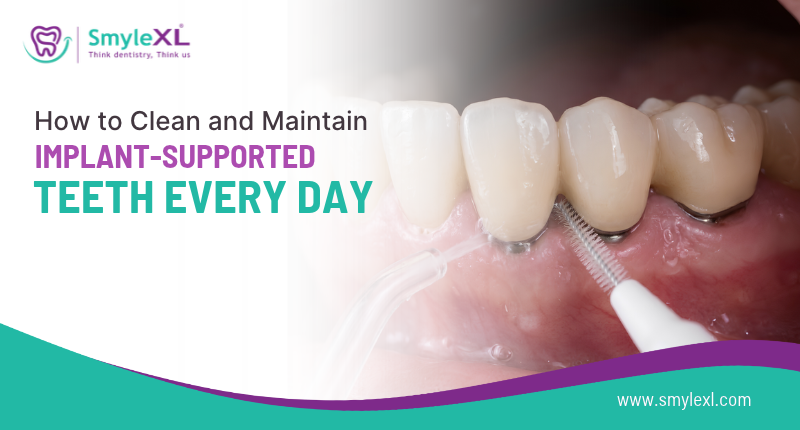
Implant-supported dentures may have areas beneath the prosthesis that a regular toothbrush can’t reach. Depending on whether the denture is removable or fixed, your dentist may recommend specialized brushes, flossing aids, or water flossers.
Your dentist may also require you to clean the prosthesis according to their instructions.
Full Mouth Dental Implants
With full mouth dental implants, cleaning beneath and around the full-arch restoration becomes especially important. Areas around the implants and under the prosthesis can collect plaque and food debris if they are difficult to access.
Patients with full mouth dental implants may therefore need specific cleaning aids and a routine designed around the shape of their restoration.
What Tools Can Help With Dental Implant Care?
No single cleaning tool works equally well for every implant restoration. Your dental examination and individual assessment can help determine which aids are appropriate.
Common options include:
- Soft-bristled toothbrush
- Electric toothbrush
- Interdental brushes
- Implant-specific floss or floss threaders
- Oral irrigators or water flossers
- Single-tuft brushes for difficult areas
A water flosser can help flush around accessible areas of an implant restoration, but it should complement mechanical plaque removal rather than replace brushing and interdental cleaning.
These are useful implant tips, but the choice of cleaning aids should consider the restoration design and the condition of the surrounding gums.
What Should You Avoid When Cleaning Implant-Supported Teeth?
Effective cleaning does not mean aggressive cleaning. Excessive pressure can irritate the gums, while unsuitable tools may damage soft tissues or the restoration.
Keep these points in mind:
- Do not use hard-bristled brushes around implants.
- Avoid aggressive scrubbing along the gumline.
- Do not use sharp objects to remove food trapped around the restoration.
- Avoid skipping difficult-to-reach areas.
- Do not assume that implants do not require regular professional care.
These simple maintenance tips can make daily dental implant care more consistent.
How Often Should Implant-Supported Teeth Be Professionally Checked?
Daily home care is only one part of long-term implant maintenance. Regular professional examinations allow the dentist to evaluate the implant, restoration, gums, and surrounding bone.
During follow-up visits, the dentist may assess plaque levels, gum condition, bite, restoration stability, and other signs that could require attention. Visit frequency depends on individual risk factors and the type of restoration.
The dentist may also recommend professional dental implant cleaning when deposits cannot be adequately removed through routine home care.
What Happens During Implant Maintenance Visits?
A maintenance appointment may include a clinical examination of the implant and surrounding tissues, evaluation of the restoration, and professional removal of plaque or calculus where required.
Your dentist may also review your home-care technique and provide personalized dental hygiene tips. If your dentist identifies an issue, they can plan further assessment or treatment before it becomes more complicated.
This is particularly relevant for patients with implant-supported teeth, because maintaining healthy tissues around the implant is an ongoing process rather than a one-time step after the implant procedure.
Does Cleaning Affect the Long-Term Health of Dental Implants?
Yes. Consistent plaque control is an important part of protecting the tissues surrounding an implant. However, several factors influence long-term outcomes, including oral hygiene, gum health, smoking, general health, implant position, restoration design, and regular professional monitoring.
Your treatment planning should therefore include both the initial procedure and an ongoing maintenance routine. The recovery timeline may finish after the tissues heal, but implant care continues afterward.
Patients should also understand that types of implants and restorations can have different cleaning requirements. The dentist can explain the specific routine based on the implant system and prosthesis used.
What About Implant Treatment Planning and Cost?
The cleaning routine is usually discussed as part of the broader implant treatment plan. At SmyleXL Dental Clinic, before dental implant treatment in Ahmednagar, our dentist usually assesses the condition of the teeth, gums, and jawbone to determine whether additional procedures are needed.
In some cases, bone grafting may be considered when there is insufficient bone volume for the planned implant. This can influence both the treatment sequence and the overall cost of treatment.
The dental implant treatment cost in Ahmednagar depends on factors such as the number of implants, type of restoration, additional procedures, and overall treatment requirements. A consultation and assessment are needed to determine the appropriate plan rather than relying on a standard price.
When Should You Contact Your Dentist About an Implant?
Don’t ignore certain changes, especially if they persist or recur.
Seek a dental assessment if you notice:
- Bleeding or swollen gums around an implant
- Persistent bad breath
- Pain or tenderness around the implant
- Difficulty chewing
- A loose-feeling restoration
- Changes in the way your teeth meet
- Food repeatedly collecting around the restoration
These signs do not automatically mean that an implant has failed. They indicate that the area should be examined to identify the cause and determine whether treatment is required.
Maintaining Implant-Supported Teeth Is a Daily Process
Successful implant care does not end once the restoration is placed. Brushing twice daily, cleaning between teeth, reaching areas beneath the restoration, and attending regular dental appointments form the foundation of implant-supported teeth maintenance.
For patients considering or already undergoing dental implant treatment in Ahmednagar at SmyleXL, the cleaning routine should be discussed as part of the overall treatment plan. SmyleXL Dental Clinic, Ahmednagar, provides dental implant treatment and related restorative care, with Dr. Onkar Kulkarni involved in patient assessment and treatment planning. The appropriate cleaning and maintenance approach depends on the implant and restoration placed.
FAQs
How often should I clean implant-supported teeth?
Brush teeth supported by implants twice a day and clean between the teeth appropriately. This should be done daily. The method used and tools will depend on what type of restoration you have, plus your dental requirements.
Can I use a water flosser around dental implants?
A water flosser may help clean around and beneath certain implant restorations. Your dentist can recommend an appropriate device and technique based on the implant design and surrounding gum condition.
Do dental implants need professional cleaning?
Yes. Home care removes daily plaque, but professional maintenance removes deposits from hard-to-reach areas and lets the dentist monitor the implant and surrounding tissues.
Can implant-supported dentures be removed for cleaning?
Some implant-supported dentures are removable, while others are fixed. Removable designs can be removed for cleaning per the dentist’s instructions, while fixed restorations require cleaning around and underneath them while they remain in place.
What happens if I do not clean my dental implants properly?
Poor plaque control can contribute to inflammation around the implant and may affect the surrounding tissues. Regular home cleaning and professional monitoring help identify and manage problems earlier.

Dr Onkar Kulkarni
Principal Dentist & Dental Care Expert
Dr. Onkar Kulkarni is a BDS-qualified dentist with 22+ years of experience, serving patients at SmyleXL Dental Clinic in Ahmednagar. He completed his BDS from Bharati Vidyapeeth’s Dental College & Hospital, Pune, and is known for his caring, patient-focused approach to dental treatment. His expertise includes comprehensive dental care, restorative dentistry, preventive dentistry and personalised treatment planning.
Professional Profile: Dr. Onkar Kulkarni
Facebook: SmyleXL Facebook
Instagram: SmyleXL Instagram
YouTube: SmyleXL YouTube