
You were brushing your teeth one morning and felt a sharp sting at the corner of your lip. You looked closer, red, raw skin. A tiny crack that burns every time you open your mouth wide. You assumed it was dry skin or maybe a cold sore. But days passed, and it didn’t go away. If this sounds familiar, you may be dealing with something far more specific than chapped lips.
At SmyleXL Dental Clinic, we offer angular cheilitis treatment in Mumbai Central. This is one of the most commonly overlooked oral conditions we see and one of the most treatable, once correctly identified.
Table of Contents
ToggleWhat Exactly Is Angular Cheilitis?
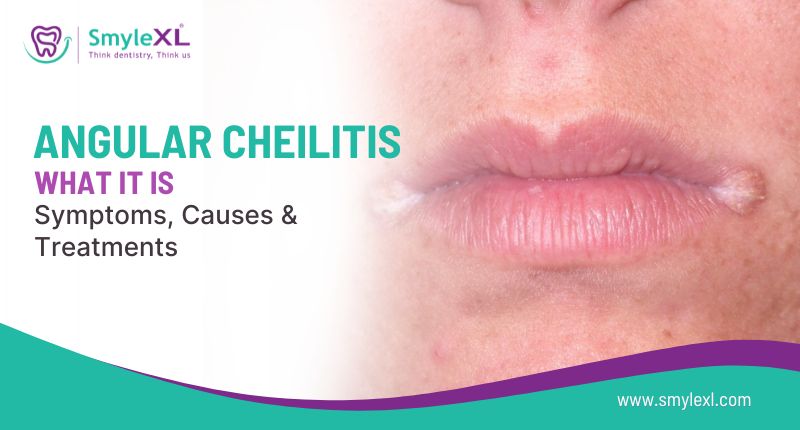
Angular cheilitis is an inflammatory condition that causes painful sores, cracks, or lesions at one or both corners of the mouth, the exact spots where your upper and lower lips meet. This mouth corner inflammation may start subtly, but it rarely stays that way. It is often associated with dryness at the corners of the mouth. You may also hear it called angular stomatitis.
Unlike a cold sore, angular cheilitis is not caused by a virus and is not contagious. It can affect anyone, children, adults, and the elderly, but is particularly common among people who wear dentures or have nutritional deficiencies. Left untreated, it can worsen over weeks, making something as simple as eating or smiling genuinely uncomfortable.
At SmyleXL, with the right angular cheilitis treatment, most patients see significant improvement within one to two weeks.
Recognizing the Symptoms – More Than Just Dry Lips
Many people dismiss the early signs as seasonal dryness or mild irritation. But angular cheilitis has a distinct and recognizable set of symptoms that set it apart.
The most noticeable sign is cracked mouth corners, small but persistent fissures at the corners of the lips that refuse to heal. Alongside this, patients often experience skin peeling at the mouth corner, where the tissue appears to flake or peel away in thin layers. This is often accompanied by a burning sensation, which intensifies during eating, speaking, or yawning.
Over time, the affected area may develop crusty lip corners, a dry, scab-like layer that forms as the skin repeatedly cracks and heals. Many patients describe painful corners of the mouth that make even a gentle smile feel like an effort. In more progressed cases, the corners may swell, bleed slightly, or produce a small amount of discharge.
The sore corners of the mouth are what most often bring patients to SmyleXL, because it stops feeling like a cosmetic issue and starts affecting daily life. For people dealing with recurring splits at the corners of the mouth, it can become genuinely frustrating.
The splits at the corner of the mouth that keep tearing open with every meal, the skin peeling at the mouth corner that never fully settles, the burning sensation in the corners that flares every time you drink something hot, these are not minor inconveniences. They are your body signaling that something needs attention.
If you have noticed any combination of these symptoms lasting more than a week, it is time to get a proper diagnosis.
Visit us soon for angular cheilitis treatment in Mumbai Central.
What Causes Angular Cheilitis?
This is where it gets interesting and where dentists genuinely have an advantage over general physicians.
Fungal infection is the most common cause. A yeast called Candida albicans, the same organism responsible for oral thrush, thrives in the warm, moist folds at the corners of your mouth. When saliva collects there and is not properly cleared due to lip-licking habits, drooling during sleep, or sagging facial skin, it creates the perfect environment for fungal overgrowth.
Bacterial infection is the second major cause. Staphylococcus aureus is found in a significant number of angular cheilitis cases, sometimes alongside Candida in what is called a polymicrobial infection.
Vitamin B2 deficiency(riboflavin), B3, B6, B12, iron, and folate weaken the skin’s barrier function and lead to painful corners of the mouth.
Dental cause of cheilitis. Ill-fitting dentures, deep overbites, and tooth loss can all reduce the face’s natural vertical height, causing the corners of the mouth to fold inward and saliva to pool.
At SmyleXL, our team is specifically trained to assess this dental dimension of the condition.
Other contributing factors include uncontrolled diabetes (which promotes fungal growth), prolonged use of steroid inhalers, a compromised immune system, certain medications that cause dry mouth, and habits such as constant lip-licking.
Angular Cheilitis Treatment: What Actually Works
Effective angular cheilitis treatment in Mumbai Central at SmyleXL begins with one essential step that most people skip: identifying the underlying cause.
Applying a random antifungal cream without knowing whether you have a fungal, bacterial, or nutritional cause is like guessing at a diagnosis.
Here is how treatment is typically approached:
For fungal infections, a topical antifungal cream is applied to the affected areas two to three times daily. In persistent cases, an oral antifungal may be prescribed.
For bacterial infections, a topical antibiotic is used. In cases where both fungal and bacterial organisms are present, combination therapy is the most effective route.
For nutritional deficiencies, correcting the deficit through targeted supplementation is essential. B-complex vitamins, iron, and folate supplements are commonly recommended alongside dietary changes.
Barrier protection – Unflavoured petroleum jelly between medication applications helps protect the lip fissure and cracked skin from further exposure to saliva and speeds healing.
Dental correction is something that sets SmyleXL’s approach apart. During your angular cheilitis treatment in Mumbai Central, we assess whether your bite, denture fit, or jaw height is contributing to the problem. Refitting dentures or addressing occlusion can eliminate the root cause entirely, rather than just managing recurring symptoms.
Most patients undergoing proper treatment at SmyleXL experience noticeable relief within 7 to 10 days. Complete healing typically occurs within two to four weeks, depending on the cause and severity.
How to Prevent Angular Cheilitis from Coming Back?
For many patients, angular cheilitis is a recurring condition, and prevention is just as important as treatment.
Keep your lips and the corners of your mouth clean and dry, especially after meals. Avoid the habit of licking your lips, which introduces more saliva and perpetuates the moisture cycle that feeds fungal growth. Stay well-hydrated and maintain a balanced diet rich in B vitamins and iron. Leafy greens, eggs, legumes, and dairy are excellent sources.
If you wear dentures, clean them thoroughly every day and soak them overnight in an appropriate solution to prevent Candida albicans from forming on the appliance. If your dentures are old or ill-fitting, a dental review at SmyleXL can assess whether a replacement or adjustment is overdue.
Managing underlying health conditions, particularly diabetes, goes a long way in reducing recurrence. People with diabetes should monitor their blood sugar levels carefully, as elevated glucose levels are a known trigger for fungal infections.
Applying a thin layer of petroleum jelly to the corners of your mouth before bed during dry weather is a simple but effective preventive habit.
Frequently Asked Questions
Is angular cheilitis contagious?
No. Angular cheilitis is not caused by a virus and cannot be passed from person to person through touch, kissing, or shared utensils. This distinguishes it clearly from cold sores.
Can it heal on its own without treatment?
Mild cases with no infection may resolve with improved lip hygiene and nutrition. However, most cases involving fungal or bacterial infection require targeted treatment to clear fully. Without treatment, the condition tends to worsen or become chronic.
Is angular cheilitis a dental problem or a skin problem?
Both, depending on the cause. When the root cause is denture fit, jaw height, or bite issues, a dentist is best placed to treat it. At SmyleXL, we take a comprehensive view and refer where needed.
How do I know if it is angular cheilitis or a cold sore?
Cold sores are caused by the herpes simplex virus, appear as fluid-filled blisters that crust over, and typically resolve within 10 days. Angular cheilitis presents as dry, cracked fissures at the corners, not blisters, and does not resolve on its own without addressing the underlying cause.
How many times will I need to visit the clinic for angular cheilitis?
For straightforward cases, one consultation is often enough to diagnose and begin treatment for angular cheilitis at our clinic in Mumbai Central. A follow-up at two weeks helps confirm resolution and rule out recurrence.
Visit SmyleXL Dental Clinic, Because Guessing Isn’t Treatment
If you have been living with painful corners of the mouth, persistent sore corners of the mouth, or crusty lip corners that just won’t heal, the team at SmyleXL Dental Clinic in Mumbai Central is here to help. We don’t just prescribe a generic cream, we look at the full picture: your oral health, your bite, your nutrition, and your habits.
Getting the right angular cheilitis treatment in Mumbai Central starts with a single appointment. Don’t let a treatable condition quietly affect your quality of life.