
If your dentist has ever said, “We need a CBCT scan,” your first reaction was probably not excitement.
It must have surely been a state of confusion, and maybe a little concerning, too.
Because anything that sounds like “CT scan” automatically makes people think about radiation, safety, and cost.
At our CBCT scan center, SmyleXL Dental Clinic in Sinhagad Road, Pune, this is one of the most common questions patients ask before undergoing advanced imaging for implant treatment planning or complex dental diagnosis.
So let’s break it down in a simple, no-stress way.
Table of Contents
ToggleWhat Is a CBCT Scan in Dentistry?
A CBCT scan, also known as cone beam CT dental imaging, is a special type of 3D scan used in modern dentistry.
It falls under advanced dental X-ray technology and is widely used in a CBCT scan center for accurate diagnosis.
Unlike traditional X-rays, which show only flat images, CBCT provides a full 3D view of:
- teeth
- jawbone
- nerve pathways
- surrounding structures
This makes it a powerful tool in oral and maxillofacial imaging.
It is also called:
- dental 3D X-ray
- dental cone beam scan
- dental tomography scan
- cone beam computed tomography
- part of digital dental radiography
Why Do Dentists Recommend CBCT Scans?
CBCT scans are not routine for every patient.
They are recommended when detailed information is needed.
Common uses include:
- implant treatment planning
- impacted tooth evaluation
- jawbone assessment
- infection detection
- sinus and nerve mapping
It is often done in a 3D dental imaging center before surgical procedures.
It helps dentists see what normal X-rays cannot show clearly.
Is CBCT Scan Safe?
This is the biggest concern patients have.
The short answer is yes, CBCT is considered safe when used appropriately.
It uses low levels of ionizing radiation, which is carefully controlled in modern machines.
Most CBCT scan center setups follow strict safety protocols, including:
- low-dose protocol settings
- targeted scanning area
- minimal exposure time
- protective shielding
At SmyleXL Dental Clinic, CBCT scans are recommended only when clinically necessary.
Radiation: Should You Be Worried?
Let’s talk about the word everyone fears: radiation.
CBCT does involve ionizing radiation in dentistry, but the dose is significantly lower compared to medical CT scans.
Understanding radiation dose in dental imaging helps put things in perspective:
- CBCT uses focused beams
- exposure is localized to the jaw area
- modern machines reduce unnecessary exposure
The effective radiation exposure is designed to be minimal while still producing high-quality images.
For comparison, a CBCT scan is generally closer to multiple dental X-rays rather than a full-body CT scan.
CBCT vs Traditional CT Scan
Many patients confuse CBCT with hospital CT scans.
But they are not the same.
A traditional CT scan:
- covers larger areas
- uses higher radiation
- is designed for full-body imaging
A CBCT scan:
- focuses only on the dental region
- uses lower radiation
- gives high-resolution 3D dental detail
This makes CBCT ideal for 2D vs 3D dental imaging comparison, where 3D clearly provides more diagnostic accuracy for dental cases.
What Happens During a CBCT Scan?
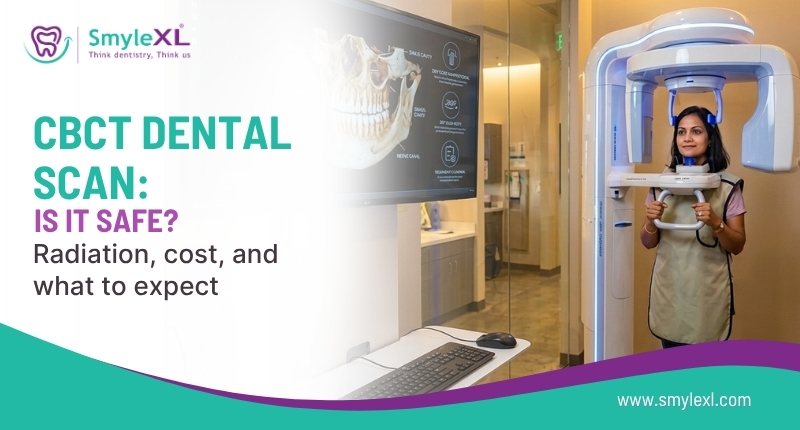
The procedure is very simple and quick.
Here’s what to expect:
- You will be asked to remove metal objects
- You will stand or sit inside the machine
- The machine rotates around your head
- You must stay still for a few seconds
That’s it.
The scan is painless and non-invasive.
There is no injection, no cutting, and no discomfort.
Most patients are surprised by how quick it feels inside a CBCT scan center.
How Long Does It Take?
A typical CBCT scan takes less than a minute to complete.
Preparation may take a few extra minutes, but the actual scanning process is extremely fast.
This speed is one reason it is widely used in modern digital dental radiography.
When Is CBCT Really Needed?
Dentists usually recommend CBCT for:
- implant placement planning
- complex root canal cases
- jaw pain diagnosis
- bone structure evaluation
- surgical extractions
Especially in implant treatment planning, CBCT helps visualize bone density and nerve positioning.
This reduces risks and improves accuracy during treatment.
What About Cost?
Cost varies depending on location and clinic setup.
At a typical CBCT scan center, pricing depends on:
- scan area required
- machine technology used
- diagnostic purpose
- clinic infrastructure
This falls under general dental imaging pricing and scanning cost categories.
While CBCT is more expensive than regular X-rays, it provides significantly more detail, which can help avoid complications in treatment.
2D X-Ray vs CBCT Scan
Let’s simplify it.
2D X-Ray:
- flat image
- limited detail
- basic diagnosis
CBCT Scan:
- full 3D view
- high precision
- deep structural analysis
This is why cone beam computed tomography is preferred for complex dental cases.
It provides a complete understanding of anatomy before procedures.
Role in Implant Treatment
One of the most important uses of CBCT is in implants.
It helps in:
- measuring bone height
- checking bone density
- identifying nerve pathways
- planning implant position
This makes implant planning more accurate and predictable.
At SmyleXL Dental Clinic, CBCT is commonly used before implant procedures to ensure safety and precision.
Are There Any Risks?
When used responsibly, risks are minimal.
However, CBCT should always be:
- clinically justified
- used only when needed
- performed with correct settings
Excessive exposure to any imaging, including digital dental radiography, should always be avoided unless necessary.
That is why dentists follow strict guidelines before recommending it.
Who Should Avoid CBCT?
CBCT is generally safe for most patients, but it is avoided unless necessary in:
- routine screening cases
- unnecessary repeat scans
Dentists always evaluate if the scan is truly needed before recommending it.
Why CBCT Is Becoming Standard in Dentistry
CBCT is becoming more common because it offers:
- better accuracy
- safer treatment planning
- improved diagnosis
- reduced surgical risk
Modern dentistry is moving toward advanced dental X-ray technology because precision leads to better outcomes.
FAQs
What should I expect during a CBCT scan?
During a CBCT scan, you will be seated comfortably while the machine rotates around your head and captures detailed images. It is quick, painless, and usually completed in a few minutes. A CBCT scan involves a controlled radiation dose in dental imaging, designed to ensure safe and accurate results. The process follows a strict low-dose protocol to keep exposure minimal while maintaining image quality. It is a safe form of ionizing radiation in dentistry when used appropriately.
Can a CBCT scan detect cancer?
A CBCT scan can show abnormal bone changes or suspicious areas, but it cannot confirm cancer on its own. It is mainly used for detailed evaluation in dentistry. It is commonly used in oral and maxillofacial imaging for identifying structural issues. Compared to 2D vs 3D dental imaging, CBCT provides better detail. In a 3D dental imaging center, advanced dental 3D X-ray systems are used, and results may also be reviewed through a dental tomography scan for deeper analysis.
Is a CBCT scan necessary for every patient?
No, it is not required for routine cases. It is recommended only when detailed imaging is needed for diagnosis or planning. A dental cone beam scan is often advised for complex cases. In a 3D dental imaging center, it helps dentists evaluate bone and tooth structure more accurately. It is a key part of oral and maxillofacial imaging in advanced dental care.
What can a CBCT scan detect?
CBCT can detect infections, fractures, and bone abnormalities that may not be visible in normal X-rays. It gives a complete 3D view of dental structures. The dental 3D X-ray helps identify hidden problems more clearly. In oral and maxillofacial imaging, it is widely used for deeper diagnosis. The 2D vs 3D dental imaging difference makes CBCT more effective, and it is often referred to as a dental tomography scan in clinical use.
Is a CBCT scan safe?
Yes, CBCT is considered safe when used correctly and only when needed. It follows strict safety guidelines. It uses a controlled low-dose protocol to reduce exposure. The radiation dose in dental imaging is carefully managed, ensuring effective radiation exposure stays minimal. Like all imaging, it involves ionizing radiation in dentistry, but at very low levels.
What is CBCT mainly used for?
CBCT is used for implants, jaw evaluation, and complex dental diagnosis. It provides high-detail imaging for better treatment planning. It is an important tool in oral and maxillofacial imaging. A dental cone beam scan is performed in a 3D dental imaging center using advanced dental 3D X-ray systems. It is sometimes referred to as a dental tomography scan in diagnostic reports.
The Tech Behind Precision!
CBCT is one of the most advanced tools in modern dentistry.
When done at a proper CBCT scan center, it provides highly accurate diagnostic information with controlled and minimal radiation exposure.
At SmyleXL Dental Clinic, Sinhagad Road, Pune, CBCT is used only when required, ensuring safety, precision, and better treatment outcomes for patients.
Good dental treatment starts with clear vision, and CBCT is what helps dentists see beyond the surface.