
Ever sat on a dental chair and heard the dentist say,
“We need to do CBCT first.”
And then wondered… Why? Is this an X-ray? Is there a difference?
Welcome to one of the most common (and confusing) topics in modern dentistry:
CBCT vs Normal X-Ray.
With advanced imaging now available even at local clinics, patients often ask whether a CBCT scan is really necessary or if a regular dental X-ray will do the job. If you’re searching for a reliable CBCT Scan Center, SmyleXL Dental Clinic will help you understand what each scan shows, when it’s used, and which one gives better results.
Let’s decode dental imaging without the boring science lecture.
Table of Contents
ToggleFirst, What Is a Normal Dental X-Ray?
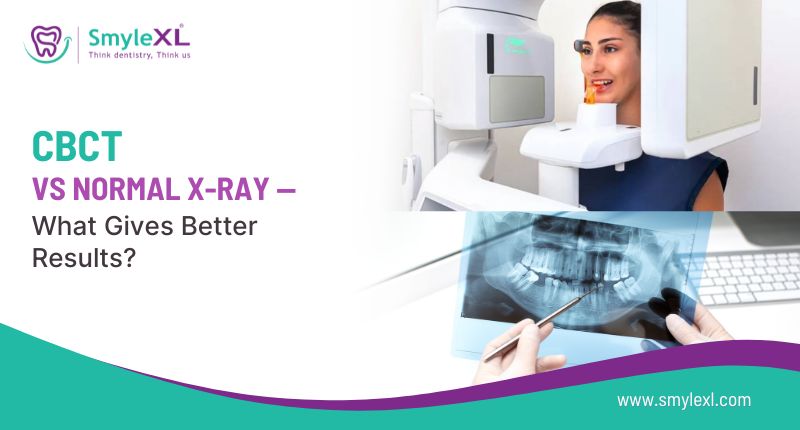
A normal dental X-ray is the most commonly used imaging method in dentistry. It gives a 2D (flat) image of your teeth and surrounding structures.
What It’s Commonly Used For:
- Detecting cavities
- Checking tooth roots
- Identifying infections
- Monitoring bone levels
- Routine dental check-ups
Why Dentists Still Use It:
- Quick and affordable
- Low radiation
- Perfect for basic dental problems
For everyday dental concerns, a normal X-ray does the job well.
Now, What Exactly Is a CBCT Scan?
CBCT stands for Cone Beam Computed Tomography, and yes, it sounds fancy because it is.
A CBCT scan gives a 3D, 360-degree view of your teeth, jawbone, nerves, sinuses, and facial structure.
What Makes CBCT Different:
- Three-dimensional imaging
- Highly detailed views
- Precise measurements
- Accurate diagnosis for complex cases
This is why clinics with advanced technology often function as a trusted CBCT Scan Center.
CBCT vs Normal X-Ray: The Big Difference
| Feature | Normal Dental X-Ray | CBCT Scan |
| Image Type | 2D | 3D |
| Detail Level | Basic | Highly detailed |
| Area Covered | Small | Full jaw & face |
| Best For | Cavities, routine checks | Implants, surgery, complex cases |
| Technology | Basic | Advanced |
Think of it like this:
Normal X-ray = regular photo
CBCT = full 3D video
When Is a Normal X-Ray Enough?
Normal X-rays are perfect when:
- You have tooth pain
- You need cavity detection
- You’re getting a filling
- You’re having routine dental exams
They’re fast, effective, and expose you to very minimal radiation.
When Does CBCT Clearly Win?
CBCT scans are used when precision matters.
CBCT Is Ideal For:
- Dental implant planning
- Wisdom tooth removal near nerves
- Root canal complications
- Jaw joint (TMJ) issues
- Sinus evaluation
- Bone loss assessment
- Facial trauma cases
In these situations, guessing is risky, and CBCT removes the guesswork.
Does CBCT Give Better Results?
Short answer: Yes, when the case is complex.
CBCT provides:
- Exact bone width and height
- Clear nerve positioning
- Accurate implant placement
- Reduced surgical risks
That’s why modern dentists rely on CBCT for predictable and safer outcomes.
Is CBCT Safe?
This is a common concern.
✔ CBCT uses significantly less radiation than medical CT scans
✔ Radiation is slightly higher than a normal dental X-ray, but still within safe limits
✔ Benefits outweigh risks in complex treatments
At a trusted CBCT Scan Center, scans are prescribed only when truly necessary.
Why Dentists Prefer CBCT for Advanced Treatments?
Imagine placing a dental implant without knowing exactly where the nerve is. Sounds risky, right?
CBCT helps dentists:
- Avoid nerve damage
- Prevent sinus complications
- Plan surgeries accurately
- Reduce treatment failures
That’s why clinics like SmyleXL Dental Clinic use CBCT to combine technology with safety.
CBCT in a Small Scan, Big Confidence
A single CBCT scan can make a big difference in how dental treatment is planned and carried out. By providing detailed, three-dimensional images, it helps reduce overall treatment time, improves diagnostic accuracy, and allows procedures to be planned more precisely.
This level of clarity increases patient confidence and significantly minimizes unexpected findings during treatment. That’s the real advantage of advanced imaging, it turns complex dental procedures into safer, more predictable experiences.
Cost: Is CBCT Worth It?
While a CBCT scan may seem more expensive than a normal dental X-ray at first, its value lies in what it helps prevent. A CBCT scan provides highly detailed, 3D information that allows dentists to plan treatments accurately from the start, reducing the chances of errors, complications, or repeat procedures.
In many cases, one CBCT scan can help avoid unnecessary treatments, shorten procedure time, and prevent post-treatment issues, making it a smart, cost-effective choice in the long run rather than an added expense.
Common Myths About CBCT (Busted!)
Myth: CBCT is only for big hospitals
Nope, modern dental clinics like SmyleXL Dental Clinic now offer it too
Myth: CBCT is dangerous
False, radiation levels are controlled and safe
Myth: Everyone needs CBCT
Not true, it’s used only when clinically required
How to Know Which Scan You Need?
- The choice between a normal dental X-ray and a CBCT scan depends on what dental problem needs to be diagnosed or treated.
- For routine issues like cavities, mild tooth pain, or regular dental check-ups, a standard dental X-ray is usually enough and provides the required information.
- When the condition is more complex, such as dental implant planning, impacted wisdom teeth close to nerves, jawbone assessment, or unexplained persistent pain, a CBCT scan is the better option.
- A CBCT scan gives a detailed 3D view, allowing dentists to clearly see bone levels, nerve positions, sinuses, and surrounding structures.
- This level of detail helps reduce guesswork, improve accuracy, and make treatments safer and more predictable.
- At advanced dental setups like SmyleXL Dental Clinic, dentists recommend the type of scan based on clinical necessity, not trends, ensuring patients receive the right imaging without unnecessary exposure.
CBCT vs Normal X-Ray: So… What Gives Better Results?
- Normal dental X-rays are excellent for routine dental care, such as cavities, fillings, and regular check-ups.
- CBCT scans offer unmatched accuracy for advanced treatments where precision matters.
Both imaging tools have their place. The real key is using the right scan at the right time, based on your dental condition, not assumptions.
If you’re planning dental implants, wisdom tooth surgery, root canal retreatment, or any advanced dental procedure, choosing a clinic equipped with CBCT technology can make a significant difference in safety and results.
At SmyleXL Dental Clinic, advanced CBCT imaging helps dentists plan treatments more accurately, reduce risks, and deliver predictable outcomes, so you feel confident every step of the way.
Better imaging → Better planning → Better results.
FAQs
Is a CBCT scan painful or uncomfortable?
No. A CBCT scan is completely painless and non-invasive. You simply stand or sit still for a few seconds while the machine captures images around your head.
Does everyone need a CBCT scan?
No. CBCT scans are recommended only for complex dental treatments like implants, wisdom tooth surgery, or detailed jaw evaluation. For routine dental issues, a normal X-ray is usually sufficient.
Is CBCT safe compared to normal dental X-rays?
Yes. CBCT uses controlled radiation levels and is considered safe when prescribed appropriately. Dentists recommend it only when the benefits of detailed diagnosis outweigh the minimal additional exposure.