
There’s a parking lot problem happening inside your mouth.
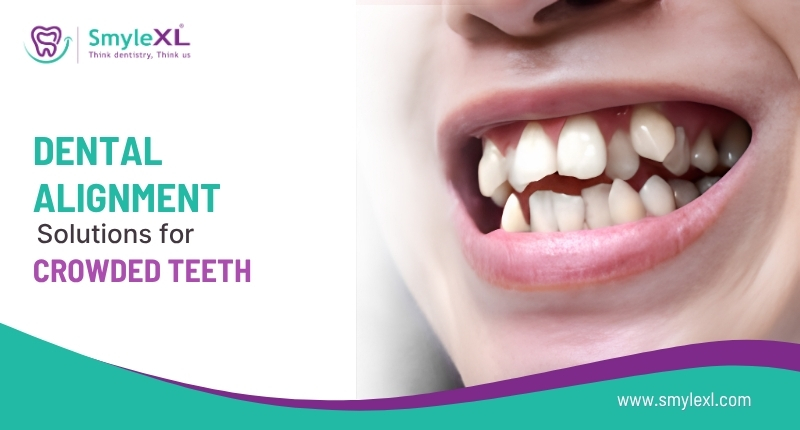
Too many cars, not enough spaces. Some are parked sideways. Some are overlapping. A couple has just given up and gone wherever they fit. That’s exactly what overlapping teeth look like from the inside, and your jaw has no traffic warden.
Crowded teeth aren’t just a cosmetic inconvenience. They’re a daily problem. Flossing becomes a battle. Brushing misses spots. Plaque finds corners it shouldn’t. And over time, what started as a cosmetic concern quietly becomes a healthy one.
Braces treatment has come a long way, and so have the alternatives. At SmyleXL Dental Clinic in Sarthana Jakat Naka , we believe every patient deserves to understand their options clearly before sitting in the chair. So let’s walk through exactly what’s causing your crowding, how to fix it, and how to choose the right path for your smile.
Table of Contents
ToggleWhy Do Teeth Become Crowded in the First Place?
Understanding the cause matters, because the severity of your crowding directly determines your treatment options.
Tooth overcrowding occurs when the jaw simply doesn’t have enough space for all the teeth to fit properly. The result is misaligned teeth that twist, overlap, push forward, or tuck behind neighboring ones. A few common reasons this happens:
- Genetics: If your parents had a crowded mouth, there’s a strong chance you inherited the same jaw-to-tooth ratio
- Early or late loss of baby teeth: When primary teeth fall out at the wrong time, permanent teeth shift into gaps they shouldn’t occupy
- Extra teeth: Some patients have more teeth than their jaw was built to hold
- Jaw size: A narrow jaw leaves permanent teeth with nowhere to go but on top of each other
Mild crowding involves one or two slightly rotated teeth. Moderate crowding means several teeth overlap noticeably. Severe crowding is when teeth are significantly twisted, stacked, or pushed entirely out of line. Your orthodontic treatment for crowded teeth starts with identifying exactly where you fall on that scale.
What Happens If You Leave Crowded Teeth Untreated?
This is the question most patients wish someone had answered earlier.
Misaligned teeth are harder to clean, full stop. Toothbrush bristles can’t reach into tight overlaps. Floss struggles to pass between teeth that are pressed together. That creates a quiet breeding ground for plaque, tartar, and eventually decay in spots you didn’t even know you were missing.
Beyond hygiene, tooth overcrowding puts uneven pressure on your bite. Certain teeth absorb more force than they should, leading to enamel wear, jaw tension, and in some cases, chronic headaches. The gums suffer too, when teeth aren’t properly aligned, gums can’t form the tight protective seal around them that keeps infection out.
Crooked teeth that are left alone don’t stay the same. They gradually worsen with age as jaw structure shifts. The earlier a dental crowding correction is addressed, the simpler and more affordable the treatment tends to be.
Braces Treatment for Crowded Teeth
At SmyleXL, Braces treatment is recommended based on the severity of your crowding, your age, your lifestyle, and what outcome you’re working toward. Here’s what’s available:
1. Traditional Metal Braces
The original, and still one of the most effective tools for dental crowding correction, especially in moderate to severe cases. Metal brackets are bonded to each tooth and connected by a wire that applies steady, consistent pressure to gradually shift teeth into alignment.
It is typically the most affordable option, highly durable, and doesn’t rely on patient compliance the way removable options do. The wire stays on, which means the work never pauses.
Best for: Severe crowding, significant bite correction, younger patients, complex cases involving rotation or significant overlap.
2. Ceramic Braces for Teeth
Same mechanism as metal braces, brackets, wires, consistent pressure, but with one key difference. The brackets are tooth-coloured, making them far less visible against the enamel. Ceramic braces for teeth are a popular choice for adults and teens who want the effectiveness of fixed braces treatment without the obvious metallic look.
They’re slightly more delicate than metal and require a little more care with staining foods and drinks, but for patients who want reliable results with a lower visual footprint, they’re an excellent middle ground.
Best for Moderate to severe crowding, adults in professional settings, patients who want fixed treatment with a discreet appearance.
Clear Aligners for Crowded Teeth
Clear aligners for crowded teeth are a series of custom-made, removable trays that gradually shift teeth into their correct positions. Each tray is worn for approximately two weeks before moving to the next in the series. There are no brackets, no wires, and no dietary restrictions.
Teeth alignment procedure with clear aligners works best for mild to moderate crowding. For patients with severe overlapping teeth or significant bite correction needs, traditional braces treatment tends to deliver more predictable results. But for the right candidate, aligners offer a nearly invisible path to straight teeth that fits around a busy lifestyle.
Best for: Mild to moderate crowding, adults, patients with compliance to wear trays 20–22 hours daily, those prioritizing aesthetics during treatment.
Braces Treatment vs. Clear Aligners — Side by Side
| Factor | Metal Braces | Ceramic Braces | Clear Aligners |
| Crowding severity | Mild to severe | Mild to severe | Mild to moderate |
| Visibility | High | Low | Minimal |
| Removable | No | No | Yes |
| Treatment duration | 18–36 months | 18–36 months | 6–24 months |
| Dietary restrictions | Yes | Yes | No |
| Compliance dependent | No | No | Yes |
| Best for | Complex cases | Aesthetics + control | Lifestyle flexibility |
What Does the Teeth Alignment Procedure Actually Look Like?
Most patients are surprised at how straightforward the process is once they start. Here’s what orthodontic treatment for crowded teeth looks like at SmyleXL from first visit to final result:
- Consultation & Diagnosis: We take digital X-rays, 3D scans, and photographs to map your crowding accurately.
- Treatment Planning: Based on severity, age, and your goals, we present the options that genuinely suit your case, not just the most popular ones.
- Fitting: Whether it’s brackets bonded to teeth or your first set of clear aligner trays, the fitting appointment is quick and straightforward.
- Active Treatment: Regular check-ins at SmyleXL every 6–8 weeks to monitor progress, adjust wires, or move you to the next aligner stage.
- Retention: Once your braces treatment is complete, a retainer keeps your newly aligned teeth exactly where they belong. This step is non-negotiable, teeth have memory, and without retention, they drift back.
How Long Does Braces Treatment Take for Crowded Teeth?
Mild crowding with clear aligners can be resolved in as little as 6 months. Moderate cases typically run 12–18 months. Severe crowding requiring fixed braces treatment with extraction or significant bite correction can take 24–36 months.
Your crooked teeth continue doing what they’re doing. Shifting. Wearing unevenly. Making cleaning harder. The treatment timeline feels long at the start, but patients at SmyleXL Dental Clinic consistently say the same thing at the end: “I wish I’d started sooner.”
Your Next Step at SmyleXL
A teeth crowding solution isn’t a luxury; it’s a health decision. Cleaner teeth. A balanced bite. A smile that doesn’t make you think twice before you give it.
At SmyleXL, we’ll tell you exactly where your crowding sits, what your genuine options are, and what braces treatment or alternative will get you to straight teeth in the most efficient, comfortable way possible.
Book your consultation at SmyleXL today. Let’s make space for the smile you’ve been working on.
Frequently Asked Questions
At what age should braces treatment start?
There’s no single answer. Children can begin early orthodontic assessment from age 7, but braces treatment typically starts between 11 and 14 when most permanent teeth are in. Adults can begin at any age, crowding doesn’t have an expiry date for treatment.
Can crowded teeth be fixed without braces?
For very mild cases, clear aligners for crowded teeth are an excellent non-brace alternative. For moderate-to-severe dental crowding correction, orthodontic braces almost always deliver more precise, lasting results.
Does dental crowding get worse with age?
Yes. A crowded mouth tends to worsen gradually as the jaw continues to shift and pressure redistributes across teeth. An early teeth crowding solution is always easier than a late one.
Is day 2 the worst for braces?
For most people, the second and third days are the most uncomfortable. The day you first get braces usually just feels strange, but the pressure gradually intensifies overnight, so by day two, you’re likely dealing with peak soreness, achiness, and sensitivity in your mouth.
Can I bite into a burger with braces?
Burgers and sushi are both fine to eat with braces, just be mindful of how you chew. Cutting food into smaller pieces is also a helpful trick. Keep in mind that for a few days after getting braces put on or following an adjustment, your teeth may feel a bit sore or sensitive.