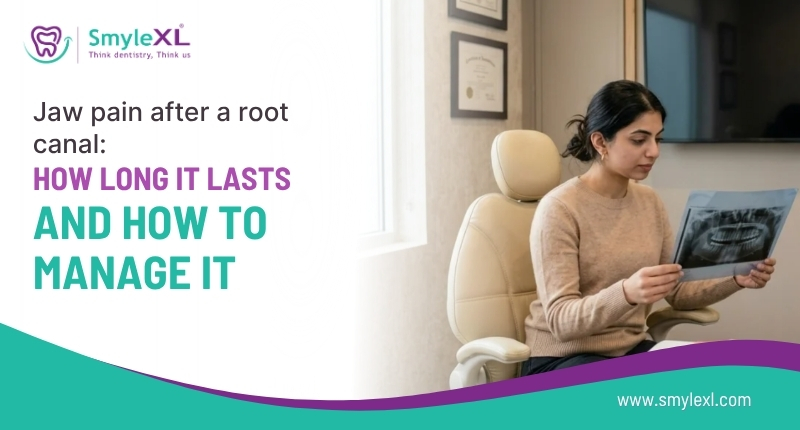

You’ve just completed your root canal treatment, and instead of feeling fully normal right away, you notice something unexpected: a dull ache or discomfort in your jaw.
Naturally, you start wondering:
“Is this normal? Did something go wrong?”
At SmyleXL Dental Clinic, this is one of the most common concerns patients have after a procedure. The good news is that mild jaw pain treatment cases after a root canal are quite common and usually temporary.
Understanding why it happens, how long it lasts, and how to manage it can help you feel much more relaxed during recovery.
Table of Contents
ToggleExpected Timeline of Jaw Pain After a Root Canal
First 24–48 Hours: Mild Soreness Is Normal
Right after Root Canal Treatment, you may feel:
- Mild jaw discomfort
- Tenderness while chewing
- Slight pressure around the treated tooth
This usually happens because your jaw muscle has been kept open for a long time during the procedure.
At this stage, mild TMJ pain or soreness is often not related to infection but to muscle strain.
Some patients also experience temporary jaw clicking or tightness due to jaw positioning during treatment.
2–5 Days: Gradual Improvement
During this phase, pain should slowly reduce.
However, you may still feel:
- Slight discomfort while chewing
- Sensitivity in the treated area
- Mild stiffness in the jaw
In some cases, underlying conditions like temporomandibular joint disorder (TMD) may make recovery feel slightly longer.
Patients who already have grinding teeth habits may notice more jaw soreness during this period.
Beyond 5–7 Days: Pain Should Be Minimal
By this time, most post-treatment discomfort should settle.
If you still experience:
- Persistent Jaw clicking
- Ongoing TMJ pain
- Difficulty opening the mouth
- Increasing discomfort
Then it may require further evaluation rather than being normal healing pain.
How to Manage Jaw Pain After a Root Canal?
1. Give Your Jaw Proper Rest
After Root Canal Treatment, avoid:
- Chewing hard foods
- Excessive talking
- Opening the mouth too wide
Your Jaw muscle needs time to recover from the strain caused during the procedure.
2. Use Warm Compress
A warm compress can help relax the muscles and improve blood flow.
This is especially helpful if your pain is related to:
- Jaw muscle fatigue
- Mild TMJ pain
- Temporary stiffness
3. Eat Soft Foods
To reduce pressure on the jaw, choose:
- Soft rice
- Soups
- Yogurt
- Mashed foods
This helps reduce chewing difficulty during healing.
Avoid hard chewing that may worsen discomfort.
4. Manage Underlying Triggers
Sometimes jaw pain is not just from the root canal itself but from existing conditions such as:
- Jaw Arthritis
- Temporomandibular joint disorder (TMD)
- Grinding teeth habits
- Previous Trauma
These conditions may increase recovery time after dental procedures.
5. Use Mouth Protection if Needed
If you have a habit of grinding teeth, your dentist may recommend mouth guards.
These help:
- Reduce pressure on the jaw
- Prevent muscle strain
- Protect treated teeth after Root Canal Treatment
6. Maintain Good Oral Hygiene
Good hygiene helps prevent complications like:
- Gum disease
- Secondary infection
- Delayed healing
Brushing gently and keeping the area clean supports faster recovery.
Other Possible Causes of Jaw Pain You Should Know
Sometimes jaw pain after treatment is not only related to the procedure.
It may also be influenced by:
Wisdom Tooth Pain
An impacted or inflamed Wisdom tooth pain can sometimes mimic post-root canal discomfort.
Mumps or Viral Infection
In rare cases, swelling from Mumps can cause jaw stiffness and discomfort.
Dislocated Jaw
Sudden strain or wide opening during treatment may rarely contribute to a Dislocated jaw sensation.
These conditions require proper diagnosis if symptoms persist.
When to Contact Your Dentist or Endodontist?
You should seek professional help for Jaw Pain Treatment if you notice:
- Pain that worsens instead of improving
- Severe swelling
- Difficulty opening the mouth
- Persistent pain beyond a week
- Continuous jaw clicking with pain
- Fever or signs of infection
- Increasing chewing difficulty
These symptoms may indicate complications from Root Canal Treatment or an underlying joint issue.
At SmyleXL Dental Clinic, we carefully evaluate whether the pain is normal healing or linked to conditions like Jaw Arthritis, TMD, or infection.
What Most People Don’t Realize About Jaw Pain After a Root Canal
You might think the pain is coming only from the treated tooth, but that’s not always true.
After Root Canal Treatment, many patients are surprised to learn that the jaw itself often plays a major role in post-treatment discomfort.
During the procedure, your mouth is kept open for a long time. Even though you may not feel it at the moment, your jaw muscle and temporomandibular joint go through continuous strain.
This is why some patients experience:
- Tightness while chewing
- Mild jaw clicking when opening the mouth
- Temporary pain that feels unrelated to the tooth
- Muscle fatigue that mimics wisdom tooth pain
In some cases, existing habits like bruxism or underlying TMD can make the jaw more sensitive after dental procedures.
Even conditions like mild Jaw Arthritis may suddenly feel more noticeable after treatment because the jaw has already been under stress.
The important thing to understand is this:
- Not all pain after a root canal means something went wrong with the tooth, sometimes your jaw is simply recovering from the effort it went through during the procedure.
- This is also why dentists often recommend gentle jaw movements, soft foods, and sometimes mouth guards for patients who clench or grind their teeth.
- Understanding this connection between the tooth and jaw can help you feel less worried and more confident during recovery.
Key Jaw Exercises for Jaw Pain Treatment
1. Relaxed Jaw Opening Exercise
This helps reduce stiffness and improve mobility.
- Sit upright in a relaxed position
- Place your tongue gently on the roof of your mouth
- Slowly open your mouth as wide as comfortable
- Hold for 5 seconds
- Close slowly without clenching
Repeat 5–10 times, 2–3 times a day.
2. Controlled Opening with Fingers (Guided Stretch)
This improves jaw flexibility in cases of temporomandibular joint disorder (TMD).
- Place two fingers under your chin
- Slowly open your mouth while providing light resistance
- Stop if you feel pain or Jaw clicking
- Hold for 3–5 seconds and close gently
Repeat 5–8 times.
3. Side-to-Side Jaw Movement
This helps improve joint coordination and reduce stiffness.
- Keep your mouth slightly open
- Slowly move your jaw to the left
- Hold for 3 seconds
- Move to the right and hold again
Repeat 5–10 times on each side.
Important Tips
- Never force movements if pain increases
- Avoid overdoing exercises
- Use warm compress before exercising for better relaxation
Healing Takes Time, But It Should Improve Daily
Mild jaw discomfort after root canal treatment is usually temporary and manageable. Most patients recover within a few days as inflammation reduces and the muscle relaxes.
Simple care steps like rest, soft foods, and warm compresses can significantly improve comfort.
However, if symptoms persist or worsen, timely jaw pain treatment is important to prevent further complications.
At SmyleXL Dental Clinic, every post-treatment case is monitored carefully to ensure your healing is smooth, comfortable, and worry-free.
FAQs
How to get rid of jaw pain after a root canal?
To reduce jaw pain after a Root Canal, you can apply a warm compress to relax the muscle, eat soft foods, and avoid excessive chewing on the treated side. Pain relief (if prescribed by your dentist) can also help. Gentle jaw relaxation exercises may reduce stiffness and pain. Most discomfort improves within a few days as healing progresses.
How do I know if my jawbone is infected after a root canal?
Jawbone infection after a root canal is rare, but warning signs include severe swelling, persistent pain that worsens instead of improving, fever, pus discharge, or difficulty opening the mouth. If you notice these symptoms, you should visit your dentist immediately for jaw pain treatment evaluation.
What is the 3 finger test for jaw pain?
The 3 finger test helps you check jaw mobility. You try to open your mouth wide enough to fit three fingers vertically between your upper and lower teeth. If you cannot do this comfortably, it may indicate TMD, muscle stiffness, or inflammation. It is commonly used to assess jaw restriction and potential TMJ-related issues after procedures such as root canal treatment.
What foods should I avoid with TMJ?
If you have jaw-pain, avoid hard, chewy, or sticky foods that strain the jaw. This includes nuts, chewing gum, hard sweets, raw carrots, and tough meats. These foods can worsen clicking jaws, increase chewing difficulty, and put extra pressure on the joint. Soft foods are recommended until symptoms improve and proper jaw pain treatment is started.
What is the best exercise for jaw pain?
One of the simplest exercises for jaw pain is the gentle, controlled opening and closing of the mouth. Slowly open your mouth while keeping your tongue relaxed, hold for a few seconds, and then close gently.