
You wouldn’t rely on directions only after you’ve taken a wrong turn. You plan your route first, so the journey stays smooth and predictable. So how can we expect a dentist to “explore” inside your jaw without a full map?
A regular dental X-ray is like a basic street sketch, it offers an outline, not the terrain. A CBCT scan, on the other hand, works like Google Maps in live view. It shows depth, angles, nerve pathways, bone thickness, and hidden risks before any treatment begins.
Inside your jaw lies a complex network of roots, sinuses, and delicate nerves. What appears simple from the chair can be unpredictable beneath the surface. That is why modern implant and surgical planning now begins at a CBCT Scan Center, not for sophistication, but for certainty.
At SmyleXL Dental Clinic, CBCT imaging is used as a planning tool, not an afterthought. Because in dentistry, what you cannot see is often what matters the most.
Table of Contents
ToggleWhat Is a CBCT Scan in Dentistry?
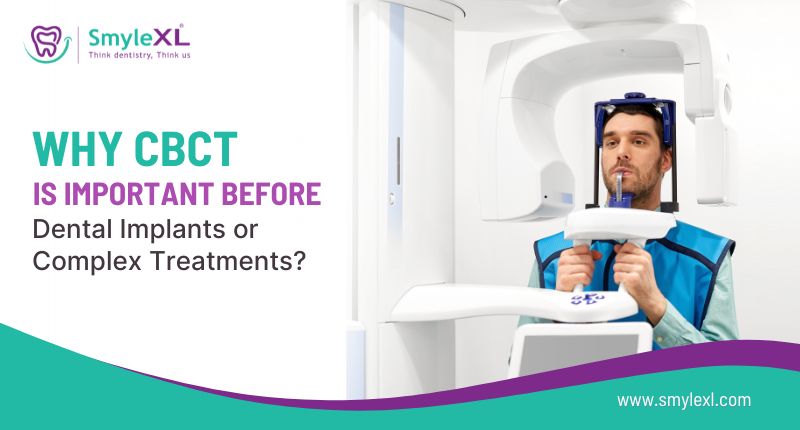
CBCT stands for Cone Beam Computed Tomography. Unlike traditional dental X-rays that provide a flat, two-dimensional image, CBCT creates a three-dimensional view of your teeth, jawbone, nerves, and surrounding structures.
In one scan, a dentist can clearly see:
- The exact height, width, and density of your bone
- The path of critical nerves
- The shape and curvature of tooth roots
- The position of sinuses
- Hidden infections, cysts, or bone defects
This level of detail is impossible with standard X-rays. A CBCT scan doesn’t just show where something is, it shows how deep, how close, and how risky it might be.
That’s why dentists refer patients to a centre for CBCT scan before implants and other complex procedures. It provides a complete map of the area, before anything is touched.
Why Regular Dental X-Rays Are Not Always Enough?
Traditional X-rays are valuable, but they compress a three-dimensional structure into a flat image. Depth disappears. Overlapping structures hide one another. Distance becomes guesswork.
What often goes unseen on 2D images includes:
- Early bone loss behind teeth
- Nerves running closer than they appear
- Extra or curved roots
- Sinus cavities dipping lower than expected
- Small infections hidden within the bone
Most dental complications arise from what wasn’t visible beforehand. A nerve injury, sinus perforation, or failed implant rarely happens because of poor technique, it happens because something important couldn’t be seen.
CBCT removes that blind spot. It replaces estimation with measurement.
The Role of CBCT in Dental Implant Planning
Dental implants are among the most precise procedures in dentistry. An implant must be placed into bone at the correct depth, angle, and location. Even a difference of two millimeters can change the outcome.
CBCT helps in implant planning by allowing dentists to:
- Measure the exact amount of available bone
- Assess bone quality and density
- Choose the correct implant size
- Determine the safest placement angle
- Identify nerve and sinus boundaries
Instead of “adjusting during surgery,” the dentist plans every detail beforehand. This means fewer surprises, shorter procedures, and safer outcomes.
Visiting a CBCT Center before implant placement is not about sophistication, it is about responsibility. It ensures that treatment is guided by anatomy, not assumption.
CBCT in Other Complex Dental Treatments
CBCT is not limited to implant dentistry. It plays a critical role in many other situations where anatomy is uncertain or risk is high.
It is commonly used for:
- Impacted wisdom tooth removal near nerves
- Retreatment of failed root canals
- Diagnosing jaw cysts and infections
- Orthodontic and alignment planning
- Evaluating jaw joints (TMJ)
In each of these cases, CBCT offers a clear advantage: it shows what lies beneath before intervention begins. This transforms treatment from reactive to planned.
How CBCT Improves Safety and Treatment Accuracy?
When a dentist can see clearly, decisions become precise.
CBCT reduces risk by:
- Preventing nerve injury
- Avoiding sinus penetration
- Reducing surgical trauma
- Shortening procedure time
- Improving long-term treatment success
It allows dentists to work with the anatomy rather than against it. This predictability benefits both patient and practitioner.
CBCT is not a luxury tool. It is a safety tool.
Is CBCT Safe? Understanding Radiation
One common concern is radiation exposure.
A CBCT scan uses radiation significantly less than a medical CT scan. It is prescribed only when the diagnostic benefit outweighs the exposure.
A responsible CBCT Scan Center follows strict safety protocols:
- Limited field-of-view scans
- Targeted imaging
- Minimal exposure settings
- Clear clinical justification
One accurate scan is far safer than multiple corrections later.
When Does a Dentist Recommend a CBCT?
A CBCT scan is usually advised:
- Before dental implant placement
- Before surgical extractions
- When pain has no clear cause
- When previous treatment has failed
- When the anatomy appears unclear on X-ray
It is chosen when clarity is essential, not routine.
Choosing the Right CBCT Scan Center
Not all scans are equal. The quality of imaging, reporting, and integration with treatment planning matters.
A reliable Center should provide:
- Modern imaging equipment
- Trained radiology staff
- Clear, interpretable reports
- Seamless sharing with dentists
- Consistent image accuracy
At SmyleXL Dental Clinic, CBCT imaging is integrated directly into clinical planning, ensuring that every decision is evidence-based.
Seeing Before Treating
Good dentistry begins before the drill. CBCT allows dentists to see what lies beneath, plan safely, and treat confidently. It prevents avoidable mistakes and transforms complex procedures into controlled ones.
In treatments where millimeters matter, clarity is not optional. That clarity begins at a CBCT Scan Center.
FAQs
Is a CBCT scan necessary for every dental procedure?
CBCT is recommended only for complex treatments where depth, nerve position, or bone structure is critical, such as implants, surgical extractions, or unexplained pain.
Does a CBCT scan hurt?
Not at all. The scan is quick, non-invasive, and painless. You simply stand or sit while the machine rotates around your head.
How long does a CBCT scan take?
The scan itself usually takes less than a minute. The entire process is completed within a few minutes.
Need Guidance Before Your Treatment?
If your dentist has recommended a CBCT scan, or if you are planning a dental implant or complex procedure, choosing a reliable CBCT Scan Center is a crucial first step. Clear imaging leads to safer planning and predictable outcomes.
At SmyleXL Dental Clinic, CBCT is used to guide treatment, not complicate it. Because when it comes to your jaw, guessing is never better than seeing.