
Nobody walks into a dental appointment expecting to make a material science decision. You came in because a tooth has been bothering you, not because you wanted to weigh clinical options like you’re in a procurement meeting. But there you are, cavity confirmed, and the dentist is asking about filling types while you’re trying to remember if you ate before coming or if that dull ache is hunger or anxiety.
It’s a very Indian situation, actually. Like going to buy curd and being asked whether you want set, hung, or Greek. The categories exist, they matter, and you wish someone had explained them before you were put on the spot. At SmyleXL Dental Clinic, patients asking about dental fillings in Vanasthalipuram land on glass ionomer most often, usually with the same question: what even is it, and is it the right one for my tooth?
“So What Exactly Is This Material You’re Recommending?”
The patient is in the chair. The X-ray is up on the screen. The cavity has been found, the tooth has been pointed out, and now the dentist pulls up a stool and says, “We have a few options for the filling material, and I want to walk you through them before we start.”
Glass ionomer comes up first.
Table of Contents
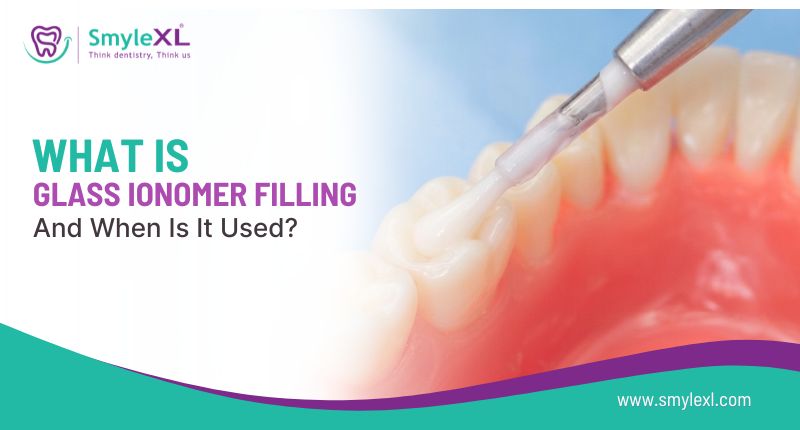
Toggle“It’s a material made from glass powder and an organic acid. When we mix them together, they form a paste that bonds directly to your tooth. It sets firm, seals the cavity, and serves as a filling. But there’s one thing it does that no other common filling material does.”
The patient leans forward slightly.
“It releases fluoride. Continuously. Into the tooth and the area around it, long after you’ve left the clinic.”
That usually gets a reaction. Because most people who come in here at SmyleXL Dental Clinic assume that dental fillings in Vanasthalipuram are passive. You put something in, it sits there, end of story. Glass ionomer doesn’t work that way. In a tooth that already had decay, having a filling that actively discourages bacteria from returning to that area is a genuine clinical advantage, not a marketing line.
“But Will It Look Obviously Different From My Other Teeth?”
Fair question, and one that comes up in almost every conversation about this material.
Glass ionomer is tooth-coloured. It sits somewhere in the off-white to light yellow range. It won’t match your enamel as precisely as composite resin, which is the white filling material most patients are familiar with. But here’s how the dentist usually explains it:
“For the situations where I recommend glass ionomer, the colour match is genuinely the last concern. What the material does for the tooth is what matters. And in those situations, it more than earns its place.”
Which leads to the next natural question from the patient sitting in that chair.
“So, When Do You Actually Use It? Why Not Just Use the White Filling Every Time?”
This is where the conversation gets specific. Because glass ionomer isn’t a generic material, and a good dentist won’t treat it like one.
For children’s teeth: “When I’m filling a baby tooth, I almost always reach for glass ionomer. Baby teeth don’t need a filling that lasts twenty years. But they do need one that protects against further decay, as children are at high risk for cavities. The fluoride release does that job continuously, and the material bonds even when the tooth isn’t perfectly dry, which, as any parent knows, is a realistic concern when you’re working with a six-year-old.”
For cavities near the gumline: “That area right where the tooth meets the gum is notoriously difficult to keep dry during a procedure. Composite resin needs a completely dry surface to bond properly. Glass ionomer doesn’t. So for cavities in that zone, it gives us a more reliable result.”
For patients who are cavity-prone: “If someone comes to us with a history of frequent cavities, dry mouth, or conditions that reduce saliva flow, the fluoride release from glass ionomer is genuinely protective. It’s not just filling one cavity. It’s helping prevent the next one.”
As a temporary filling: “Sometimes a tooth needs protection while we plan something bigger, like a crown or a more involved restoration. Glass ionomer works well as an interim material that does a real job while we wait.”
The patient nods slowly. “So it may not be for every tooth, but when it fits, it actually fits well.”
Exactly.
“What About Strength? Will It Hold Up?”
This is the part of the conversation where honesty matters most.
“Glass ionomer is not the strongest filling material we have. For a large cavity on a back tooth that takes the full force of chewing every day, composite resin or a different material is the better call. Glass ionomer in a high-load area wears down faster and doesn’t last as long.”
The patient appreciates the straight answer.
“Typically, a glass ionomer filling lasts three to five years in a stress-bearing area. In lower-load areas, like the gumline, it can last considerably longer. In a baby tooth, it lasts until the tooth falls out naturally, which is exactly how long it needs to.”
Compared to composite resin:
| Property | Glass Ionomer | Composite Resin |
| Fluoride release | Yes, continuous | No |
| Moisture tolerance | Bonds in slight moisture | Needs dry field |
| Colour match | Acceptable | Excellent |
| Strength | Moderate | Higher |
| Lifespan | 3 to 5 years in load areas | Longer |
| Best suited for | Children, gumline, high-risk cases | Most adult permanent cavities |
“What Happens During the Actual Procedure?”
The dentist walks through it while the patient is still in the chair, so there are no surprises once treatment begins.
- The decayed portion of the tooth is removed
- The cavity is cleaned and mildly conditioned to prepare it for bonding
- The glass ionomer is mixed and placed while it’s still workable
- It’s shaped to fit the tooth before it sets
- A protective coating goes over the surface immediately after placement
“Initial setting takes a few minutes. Full hardening continues over the next day or so. We ask that you avoid anything hard or chewy on that tooth for the rest of today. By tomorrow, it’s fully functional.”
The whole appointment, for a straightforward filling, runs between thirty and forty-five minutes.
Before the Patient Gets Up From the Chair
“Any other questions before we start?”
There usually are. And that’s exactly the point. At SmyleXL Dental Clinic, every patient receiving dental fillings in Vanasthalipuram gets this conversation before anything goes into their mouth. The material, the reasoning, the expected lifespan, and what to watch for.
The filling itself takes a few minutes. The decision behind it takes longer, and it should.
If a tooth has been bothering you, or a recent check-up flagged something that needs attention, come in. We’ll show you the X-ray, explain what we’re seeing, and walk through the options the same way, until you’re comfortable with exactly what’s happening and why.