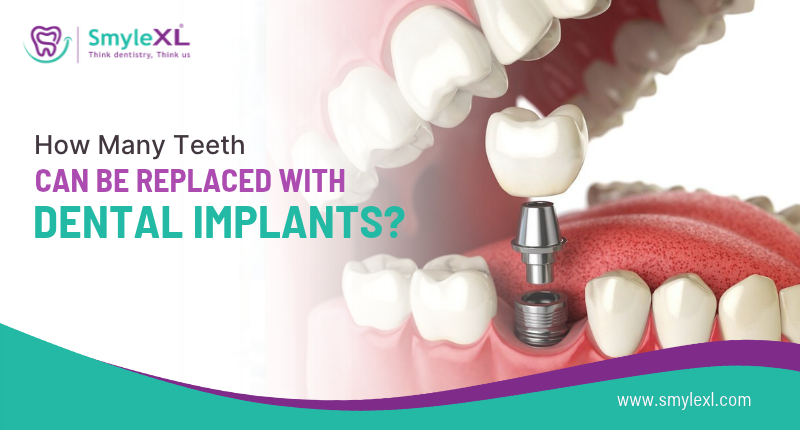

Dental implants can replace one missing tooth, several teeth, or an entire arch. However, you do not necessarily need one implant for every tooth you have lost. The number of implants needed depends on the location of the missing teeth, available bone, bite, and the type of restoration planned.
For example, one implant can support a single replacement tooth, while two or more implants may support an implant-supported bridge. For complete tooth loss, four or six strategically placed implants may support a full-arch restoration in selected cases.
Understanding these options can help you see why dental implant treatment is planned around your overall dental condition rather than simply counting the teeth that are missing.
Table of Contents
ToggleWhat Will You Find on This Blog?
Here’s a quick look at what this guide covers:
- How many teeth dental implants can replace
- Whether one implant can support more than one replacement tooth
- Options for replacing several missing teeth
- How full-arch implant treatment works
- The role of All-on-4 and All-on-6
- Factors that determine the number of implants
- How bone condition affects treatment planning
- What happens during the implant procedure
How Many Teeth Can Dental Implants Replace?
Dental implants can replace anywhere from one missing tooth to an entire arch of teeth, depending on your dental condition and the restoration being planned. The number of implants may be lower than the number of teeth being replaced.
A titanium implant is placed in the jawbone and acts as an artificial tooth root. An abutment connects the implant to the final replacement tooth or restoration.
Depending on your needs, dental implants for missing teeth may be used for:
- One missing tooth
- Several adjacent missing teeth
- Multiple gaps in one or both jaws
- A complete arch of missing teeth
This flexibility makes tooth replacement with implants suitable for several different patterns of tooth loss.
Can One Dental Implant Replace More Than One Tooth?
One implant does not normally replace two separate teeth by itself, but it can sometimes serve as one of the supports for a restoration replacing multiple teeth. This is commonly possible with an implant-supported bridge.
For instance, if you have two or three adjacent missing teeth, implants can be strategically positioned to support a bridge containing several replacement teeth. This means an individual implant does not necessarily need to be placed under every replacement tooth.
The number and position of implants depend on the gap, surrounding teeth, available bone, bite, and planned restoration.
How Does Single Tooth Replacement Differ From Multiple Tooth Replacement?
Single tooth replacement usually involves one implant and one replacement tooth, while multiple tooth replacement may use several implants or an implant-supported bridge. The choice depends on where the teeth are missing and how the restoration needs to be supported.
What Happens When One Tooth Is Missing?
A single tooth dental implant can replace an individual missing tooth without using neighboring natural teeth as bridge supports. The implant post is placed in the jawbone, followed by the abutment and final restoration when appropriate.
What Happens When Several Teeth Are Missing?
With multiple dental implants, implants can be placed at selected positions to support several replacement teeth. If the gaps are next to each other, an implant-supported bridge may be considered.
This can provide a different approach from placing an individual implant for every missing tooth.
How Many Implants Are Needed for a Full Mouth?
There is no single number of implants required for every full-mouth case. Depending on the restoration and your oral condition, a complete arch may be supported by four, six, or another number of implants.
Two commonly discussed approaches are:
- All-on-4 dental implants: Four implants may support a complete fixed arch in selected cases.
- All-on-6 dental implants: Six implants may support a full arch when appropriate.
These approaches do not mean that four or six implants are automatically suitable for everyone. Your jawbone health, bite, anatomy, and restoration design all need to be assessed before deciding on the treatment.
Let’s understand your options better!
| Tooth Loss | Possible Implant Approach | Typical Support |
| 1 missing tooth | Single tooth dental implant | 1 implant + 1 crown |
| 2–3 adjacent teeth | Implant-supported bridge | 2 or more implants |
| Several missing teeth | Multiple dental implants | Implants + individual crowns or bridge |
| Complete arch | Full-arch restoration | All-on-4, All-on-6, or another planned configuration |
Can Dental Implants Replace All Missing Teeth?
Yes, dental implants can be used to replace all missing teeth in selected patients, but the replacement may be supported by fewer implants than the total number of teeth.
For someone with complete tooth loss in one arch, a full-arch restoration can be supported by strategically positioned implants. This can provide a fixed replacement option without placing a separate implant beneath every artificial tooth.
The final approach depends on bone availability, restoration design, and overall oral health.
To understand whether dental implant treatment is suitable for your tooth-loss pattern, visit your nearby dental clinic and discuss your options.
What Determines the Number of Dental Implants Needed?
The number of implants needed is determined by the number and position of missing teeth, available bone, bite, and the type of restoration being planned. Simply counting your missing teeth is not enough to determine the implant requirement.
Talk with a specialist who can assess your missing teeth, jawbone condition, and restoration needs to develop an appropriate implant plan.
Does the Location of Missing Teeth Matter?
Yes. The position of the gaps affects how implants can be distributed and how the replacement teeth will be supported. Several adjacent missing teeth may be suitable for an implant-supported bridge, while isolated gaps may require individual restorations.
Does Bone Condition Affect Implant Planning?
Yes. Bone density and available jawbone influence where an implant can be placed and how it can be supported.
After tooth loss, the surrounding bone can gradually change. If there is not enough bone in the required area, bone grafting may sometimes be considered as part of the treatment plan.
Are Dental Implants Suitable for Everyone?
Dental implants are not automatically suitable for every person; suitability depends on your oral condition, available bone, general health, and ability to maintain the restoration.
Your dentist may evaluate your gums, remaining teeth, jawbone health, bite, and overall dental condition before recommending implants.
Age alone does not determine eligibility. The condition of the mouth and whether the proposed restoration can be appropriately supported are more relevant to planning dental implant treatment.
Can Dental Implants Be Used With Dentures?
Yes, implants can be used to support certain types of dentures. These are called implant-supported dentures, where implants provide attachment and stability for the denture.
This is different from a conventional removable denture, which rests primarily on the gums and surrounding tissues. The number of implants required depends on the type of denture, jaw, available bone, and planned design.
For people with extensive tooth loss, this can be one of several tooth replacement options to discuss with a dentist.
What Happens During the Dental Implant Procedure?
The dental implant procedure generally involves assessment, implant placement, a healing period, and placement of the final restoration. The exact sequence can vary depending on the number of teeth being replaced and the restoration selected.
How Is Treatment Planned?
The dentist evaluates the missing teeth, surrounding structures, bite, gums, and bone density. Imaging may be used to understand the jawbone and determine suitable implant positions.
How Is the Implant Placed?
The implant post is placed into the jawbone at the planned location. The number of implants depends on the restoration they are intended to support.
When Is the Final Restoration Placed?
After the implant has undergone the required healing and integration with the surrounding bone, the abutment and final restoration can be placed when appropriate.
The completed implant restoration may be a single crown, bridge, denture, or full-arch replacement.
What Role Does Bone Grafting Play in Implant Treatment?
Bone grafting may be considered when there is insufficient bone volume or density to support the planned implant placement. It is not required for every implant patient.
Your dentist first assesses the available bone and determines whether grafting is necessary. The decision can affect the sequence and timing of dental implant treatment.
This is another reason why the number of implants cannot be decided simply by counting multiple missing teeth.
If you’re concerned about whether your jawbone can support dental implant treatment, a dentist can evaluate your bone condition and explain the available treatment approach.
How Should You Choose Between Different Implant Restorations?
The appropriate restoration depends on how many teeth are missing, where they are missing, your bone condition, and the type of support required.
For example:
- One missing tooth may be replaced with an individual implant and crown.
- Several adjacent gaps may be restored with an implant-supported bridge.
- Extensive tooth loss may be managed with implant-supported dentures.
- Complete loss of teeth in an arch may allow consideration of a full-arch restoration supported by multiple implants.
Your treatment plan should therefore focus on the overall arrangement of your teeth and jaw rather than simply the number of teeth lost.
What Should You Consider Before Choosing Implant Treatment?
You should consider the condition of your jawbone, location of the missing teeth, planned restoration, bite, and long-term maintenance before deciding on implant treatment.
A clinical evaluation helps determine whether you need a single implant, multiple dental implants, a bridge, dentures, or a full-arch restoration.
It is also useful to understand the difference between the implant itself and the final restoration. The implant post, abutment, and replacement tooth each serve different functions within the completed treatment.
Frequently Asked Questions
Can Dental Implants Be Placed After Years of Tooth Loss?
Yes, implants may still be possible after long-term tooth loss. However, the condition of the jawbone needs to be evaluated because bone changes can occur after a tooth has been lost.
Is an Implant-Supported Bridge Fixed or Removable?
An implant-supported bridge is a fixed restoration, not one you remove yourself. Its design depends on the location of the missing teeth and the available implant support.
How Many Teeth Can an Implant-Supported Bridge Replace?
An implant-supported bridge can replace several adjacent teeth, but the appropriate number depends on the gap, implant support, bite, and restoration design. Your dentist determines the suitable span during treatment planning.
Does Every Implant Need a Crown?
Not necessarily. An implant may support a crown, bridge, denture, or full-arch restoration depending on the treatment plan. The final restoration determines how the implant is used.
Can Bone Loss Be Evaluated Before Implant Placement?
Yes. The dentist can assess the available bone using a clinical examination and appropriate imaging. This helps determine whether the planned implant position has adequate support or whether bone grafting should be considered.
Are All-on-4 and All-on-6 the Same Treatment?
No. Both are full-arch implant approaches, but All-on-4 uses four implants while All-on-6 uses six. The appropriate configuration depends on your anatomy, bone condition, and planned restoration.
What Should You Always Remember While Considering Dental Implant Treatment?
Dental implant treatment can replace one tooth, several teeth, or an entire arch, but the number of implants does not necessarily equal the number of missing teeth. A single implant may support one replacement tooth, several implants can support a bridge, and a full arch may be supported by four, six, or another appropriate number of implants.
The final plan depends on your missing teeth, jawbone condition, bite, and restoration requirements. Understanding these factors can help you have a more informed discussion about your available tooth replacement options and the number of implants your treatment may require.
At SmyleXL Dental Clinic, we provide dental implant treatment in Sinhagad Road, Pune, that can help you understand whether a single implant, bridge, dentures, or a full-arch restoration may be appropriate for your needs.

Dr. Ganesh C. Kulkarni
Principal Dentist & Dental Care Expert
Dr. Ganesh C. Kulkarni is a BDS-qualified dentist with 22+ years of experience, serving patients at SmyleXL Dental Clinic on Sinhgad Road, Pune. He completed his BDS from Bharati Vidyapeeth, Pune, and has extensive experience providing comprehensive dental care. Known for his caring and patient-focused approach, Dr. Kulkarni is committed to providing personalised treatment and comfortable dental experiences.
Professional Profile: Dr. Ganesh C. Kulkarni
Facebook: SmyleXL Facebook
Instagram: SmyleXL Instagram
YouTube: SmyleXL YouTube