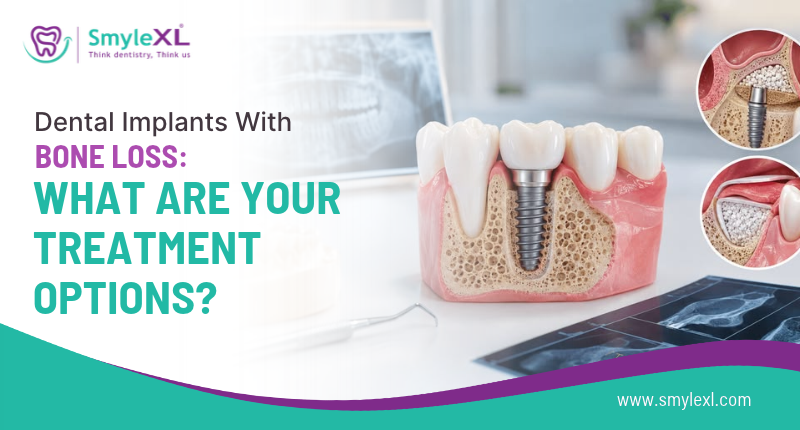

You’ve had a missing tooth for a long time and have finally decided to get a dental implant. But now, you find out that you don’t have enough jawbone to support it.
Now what? Are your implant plans canceled? Should you just give up on the idea?
Wait! Before you jump to conclusions, let us tell you something.
When something goes wrong, our first instinct is often to find a “JUGAAD”. And you won’t be surprised if we tell you that, in dentistry, we also have a “Jugaad” to address dental implants with bone loss, depending on your condition.
There are actually several ways to tackle this! Your dentist may suggest bone grafting, a sinus lift, or even a different implant technique, depending on how much bone you’ve lost.
Table of Contents
ToggleHow Does Bone Loss Affect Getting An Implant Done?
A dental implant needs a strong foundation: YOUR JAWBONE. When a tooth is missing for a long time, the bone in that area may gradually shrink. Gum disease, infections, and injuries can also contribute to bone loss.
Why Is Jawbone Important for Dental Implant Treatment?
Your jawbone supports the implant and helps it stay stable as it bonds with the surrounding bone. If the bone lacks sufficient height or width, placing an implant in the planned position can become difficult.
Here’s how bone availability can affect your treatment:
A.Enough bone available
Your dentist may be able to place the implant directly, depending on your oral health.
B.Insufficient bone
Bone grafting or an alternative implant technique may be considered to address the lack of support.
Bone loss doesn’t automatically mean you cannot get dental implants. A dental examination and, when indicated, a CBCT scan can help your dentist assess the available bone and plan the next steps.
What Do Dentists Do In This Condition?
At SmyleXL Dental Clinic in Kothrud, Pune, we assess the available jawbone and overall oral health before planning dental implants with bone loss.
The treatment depends on where the bone loss has occurred and how severe it is. A person missing one tooth may need a different approach from someone who has lost several teeth or most of the teeth in one jaw.
Here are the main options your dentist may consider.
1. Bone Grafting: When the Jawbone Is Too Thin or Short
Bone grafting is one option when the jawbone does not have enough volume to support an implant in the desired position.
During this procedure, a graft material is placed in the area where additional bone is needed. The material may come from the patient’s own bone, a processed donor or animal source, or a synthetic material. The choice depends on the clinical situation and the dentist’s assessment.
Over time, the grafted area heals and develops into a stronger foundation for treatment.
When it might be recommended?
- When the jawbone has become too narrow after tooth loss.
- When there is insufficient bone height or volume for the planned implant.
- When bone loss has occurred following an extraction, injury, or gum disease.
Bone grafting is not automatically necessary for every person with bone loss. The decision depends on the amount and location of the missing bone.
2. Sinus Lift: When There Is Not Enough Bone in the Upper Back Jaw
A sinus lift is a specific type of grafting procedure used for certain implants in the upper back jaw.
It creates additional space for bone graft material by gently raising the sinus membrane.
When it might be recommended?
- When an upper premolar or molar is missing.
- When the bone between the jaw ridge and the sinus is too short.
- When the planned implant cannot be supported safely by the available bone height.
It is not usually the treatment for bone loss in the lower jaw because the lower jaw does not have maxillary sinuses. Other techniques may be considered for lower jaw dental implants with bone loss.
3. Short or Narrow Implants: When There Is Limited Space
In selected cases, a dentist may consider a shorter or narrower implant to work with the bone that is already available.
These implants have specific dimensions and are not suitable for every situation. Their use depends on the location of the missing tooth, the quality and quantity of the remaining bone, bite forces, and the planned restoration.
When might this option be considered?
- When the available bone height or width is limited.
- When a suitable implant can be placed without compromising important anatomical structures.
- When the clinical assessment supports this approach instead of additional grafting.
This option may reduce the need for some bone augmentation procedures in suitable cases. However, it is not a shortcut that works for everyone.
4. Zygomatic Implants: For Certain Cases of Severe Upper Jaw Bone Loss
What happens when there is very little bone left in the upper jaw?
For selected patients with severe upper jaw bone loss, a specialist may consider zygomatic implants. Unlike conventional dental implants, these longer implants are anchored in the cheekbone, also called the zygomatic bone.
When it might be considered?
- When there is severe bone loss in the upper jaw.
- When conventional implants would require extensive grafting or may not be feasible.
- When a specialist determines that the cheekbone can provide an appropriate anchoring site.
It requires careful planning and specialized surgical expertise. They are not a routine alternative for a single missing tooth, and they are not a treatment for lower jaw bone loss.
How Long Does Implant Treatment Take When There Is Bone Loss?
The treatment timeline depends on whether bone grafting is required, how much bone needs to be rebuilt, and how well the area heals.
| Treatment approach | General healing or treatment timeline |
| Implant without additional grafting | Often around 3–6 months for implant integration and restoration, depending on the case |
| Bone grafting before an implant | Graft healing may take around 3–6 months or longer before implant placement |
| Sinus lift | Healing may take several months, often around 4–9 months for more extensive grafting |
| Zygomatic implants | The timeline depends on the surgical plan and when the final restoration can safely be fitted |
These are broad estimates, not guaranteed timelines. Some procedures can be combined, while others require separate stages of treatment.
Your dentist will monitor healing before deciding when to proceed. Factors such as smoking, uncontrolled medical conditions, gum disease, and the extent of the surgery may affect recovery.
FAQs
How long does recovery take after dental implants with bone loss?
Recovery depends on the procedure. Swelling and tenderness may improve within days, but bone grafts and implants can take several months to heal fully.
How much do dental implants with bone loss cost?
The cost depends on the implant, the extent of bone loss, and whether grafting or a sinus lift is needed. Ask for a treatment estimate that includes all procedures and the final crown.
Is bone grafting always necessary before dental implants?
No. If enough suitable bone is available, an implant may be placed without grafting. In some cases, grafting can be performed during implant placement. Your dentist will decide based on clinical findings and imaging.
Can lower jaw dental implants be placed with bone loss?
Yes, in some cases. Treatment may involve grafting or another suitable implant approach. The lower jaw has important nerves and other anatomical structures, so careful assessment of the available bone is essential.
Are zygomatic implants suitable for everyone with bone loss?
No. They are generally considered for selected cases of severe bone loss in the upper jaw and require specialist assessment. They are not a standard option for every missing tooth.
Considering Dental Implants With Bone Loss?
Bone loss can affect your dental implant treatment plan, but the available options depend on your individual oral health and jawbone condition.
At SmyleXL Dental Clinic, Kothrud, Pune, you can discuss dental implant options, the need for additional procedures, estimated treatment costs, and expected healing time following a clinical assessment.
Contact SmyleXL Dental Clinic in Kothrud, Pune, to enquire about a dental implant consultation.

Dr Rohan Nakhole
Principal Dentist & Dental Care Expert
Dr. Rohan Nakhole is a BDS-qualified dentist with 14+ years of experience, serving patients at SmyleXL Dental Clinic in Kothrud, Pune. His areas of expertise include dental implants, cosmetic dentistry, restorative dentistry and comprehensive dental care. He is known for his patient-focused approach, ethical treatment planning and commitment to staying updated with modern dental advancements.
Professional Profile: Dr. Rohan Nakhole
Facebook: SmyleXL Facebook
Instagram: SmyleXL Instagram
YouTube: SmyleXL YouTube