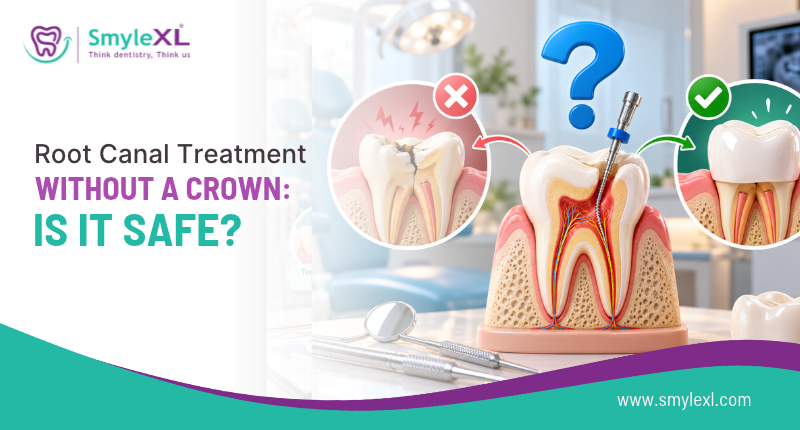

There’s a very common sequence of events that plays out after a root canal. The procedure is done, the tooth feels fine, the dentist mentions a crown, and somewhere between that appointment and actually getting one, life happens. Weeks turn into months. The tooth isn’t hurting. It seems okay. So the crown gets pushed back, and then pushed back again, until it quietly disappears from the to-do list entirely.
It’s one of the most frequent post-root canal mistakes, and one of the most avoidable. Here’s why root canal treatment without a crown is a problem, what actually happens to a treated tooth over time without proper coverage, and why the crown isn’t a follow-up suggestion but a clinical necessity.
Table of Contents
ToggleWhat Happens to a Tooth During Root Canal Treatment
To understand why a crown is non-negotiable, it helps to understand what root canal treatment actually does to the tooth structure.
During endodontic therapy, the infected pulp (the soft tissue containing nerves and blood vessels inside the tooth) is removed. The dental pulp chamber and root canals are cleaned, shaped, and sealed. The tooth is saved. But what’s left behind is structurally different from what was there before.
A tooth with its pulp intact gets moisture and nutrients from the blood supply running through it. Once that supply is removed, the tooth loses that internal nourishment. Over time, it becomes drier and more brittle, significantly more susceptible to cracking under normal bite force on treated tooth than a living tooth would be.
Add to that the access cavity cut into the tooth during the procedure, removing enamel and dentine to reach the canals, and you have a tooth that’s structurally compromised from two directions at once.
Why Root Canal Treatment Without a Crown Is a Problem
Tooth Fracture Risk
Tooth brittleness after nerve removal is the most immediate concern of a root canal treatment without a crown. A tooth that’s had its pulp removed and hasn’t been covered is significantly more likely to crack or fracture under that load.
The fracture that results from leaving treated tooth without coverage isn’t always a clean, manageable crack. It can split the tooth vertically through the root, which typically means extraction. A tooth that survived the root canal, that could have lasted decades with a crown, is lost to a fracture that a crown would have prevented.
Risk of tooth fracture isn’t a rare complication. It’s a predictable outcome of leaving a treated tooth unprotected for long enough.Weeks turn into months. The tooth isn’t hurting. It seems okay. So the crown gets push
Bacterial Reinfection
Bacterial reinfection of tooth is the other major consequence of skipping crown after root canal. The temporary filling placed after root canal treatment isn’t designed for long-term use. It degrades. Micro-gaps develop. Bacteria find their way back in, and the canals that were carefully cleaned and sealed become reinfected.
Root canal filling without permanent cap relies on that temporary material holding indefinitely. It won’t. And once bacterial reinfection of tooth takes hold, the options narrow. Retreatment if possible, extraction if not.
Structural Collapse
Beyond fracture and infection, a root canal treatment without a crown can wear down or break in ways that make restoration increasingly difficult. Tooth longevity without restoration drops significantly with each passing month the tooth is left unprotected, not because the root canal failed, but because the tooth above it wasn’t given the protection it needed to survive.
Crown vs No Crown After Root Canal — The Data
Crown vs no crown after root canal isn’t a matter of preference or budget; it’s a matter of outcomes.
Published research suggests that teeth restored with crowns after root canal treatment may have better long-term survival than those restored with fillings alone. One systematic review reported a 10-year survival rate of approximately 81% for crowned teeth, compared with 63% for teeth restored with direct fillings. However, long-term survival also depends on the remaining tooth structure, tooth position, and overall oral health.
| With Crown | Without Crown | |
| Long-term tooth survival rate | Over 80% at 10 years | Significantly lower |
| Risk of tooth fracture | Substantially reduced | High, especially back teeth |
| Bacterial reinfection of tooth | Minimised | Increases over time |
| Bite force on treated tooth | Distributed and protected | Concentrated on vulnerable structure |
| Tooth brittleness after nerve removal | Managed by crown coverage | Progressive and unmanaged |
The numbers make the case clearly. Endodontic therapy without dental crown is not a long-term solution; it’s an incomplete one.
Which Teeth Are Most at Risk?
Risks of uncapped root canal aren’t equal across all teeth, but that doesn’t mean any tooth is exempt from needing a crown. Front teeth (incisors and canines) bear less chewing load than back teeth, which means the risk of tooth fracture is somewhat lower. But bacterial reinfection of tooth, structural compromise, and tooth brittleness after nerve removal remain real concerns regardless of tooth position. Back teeth (molars and premolars) are at highest risk given the bite force on treated tooth they absorb with every meal. The clinical urgency may vary by tooth. The need for a crown does not.
How Long Is Too Long to Wait?
Most dentists recommend getting a crown placed within 4–6 weeks of completing root canal treatment. This isn’t arbitrary; it’s the window during which the temporary filling is reasonably intact, and the risk of bacterial reinfection of tooth is still low.
Beyond that window, every week adds to the cumulative risk. Leaving treated tooth without coverage for months isn’t neutral; it’s actively increasing the probability of fracture or reinfection with each passing day.
Root canal filling without permanent cap was never meant to be the endpoint. It’s a placeholder, and treating it as anything more is where the problem begins.
What Good Post Root Canal Tooth Care Looks Like
Post root canal tooth care isn’t complicated, but it is specific:
- Get the crown placed within the recommended window. Don’t treat it as optional
- Until the crown is in place, avoid hard, crunchy, or chewy foods on that side
- Don’t ignore sensitivity or discomfort; it can signal early reinfection or fracture risk
- Attend follow-up appointments; the dentist needs to confirm the tooth is responding well before the crown goes on
- Once the crown is placed, maintain it with regular brushing, flossing, and check-ups
The root canal saves the tooth. The crown is what keeps it saved.
Frequently Asked Questions
How long can a tooth last without a crown after root canal?
There’s no fixed answer. It depends on the tooth’s location, how much structure remains, and how much chewing load it takes. What published data on long-term tooth survival rate consistently show is that root canal treatment without a crown, particularly on back teeth, leads to significantly higher rates of fracture and failure over time. The tooth may feel fine for months. That doesn’t mean it’s stable. Tooth brittleness after nerve removal is a progressive issue, not an immediate one.
What happens if you don’t put a crown on a root canal?
Skipping crown after root canal leaves the tooth vulnerable to two main outcomes: fracture from bite force on treated tooth, and bacterial reinfection of tooth through a degrading temporary filling. Either can result in losing a tooth that the root canal successfully saved. Risks of uncapped root canal are well-documented; leaving treated tooth without coverage is not a neutral decision; it’s a deteriorating one.
Can I eat normally after root canal without a crown?
Not on that side, and not with hard or chewy foods. Root canal filling without permanent cap leaves the tooth structurally vulnerable. Normal eating, particularly anything that puts significant bite force on treated tooth, increases fracture risk substantially. Post root canal tooth care during the period between root canal completion and crown placement means treating that tooth carefully, not normally.
Is a crown always necessary after root canal?
Yes. The risk of tooth fracture without coverage is too high given the chewing forces your teeth handle. Crown vs no crown after root canal isn’t a patient preference question; it’s a clinical one, and for most teeth the answer is clear.
How soon after root canal should I get a crown?
Within 4–6 weeks is the general recommendation. This is the window during which the temporary restoration is still reasonably intact and bacterial reinfection of tooth risk remains low. Endodontic therapy without dental crown beyond this window means the temporary filling is working harder than it was designed to, and the dental pulp chamber access cavity remains inadequately protected. The sooner the permanent crown is placed, the better the long-term tooth survival rate.

Dr. Dipti Jaju
Chief Dentist & Cosmetic Dental Surgeon
Dr. Dipti Jaju is the Chief Dentist at SmyleXL Dental Clinic, Pimple Nilakh, with expertise in smile designing, invisible aligners and root canal treatments. She completed her BDS from D. Y. Patil College, Pune, and has performed 1,000+ root canal treatments. She is committed to providing personalised, comfortable and patient-focused dental care.
Professional Profile: Dr Dipti Jaju
Facebook: SmyleXL Facebook
Instagram: SmyleXL Instagram
YouTube: SmyleXL YouTube