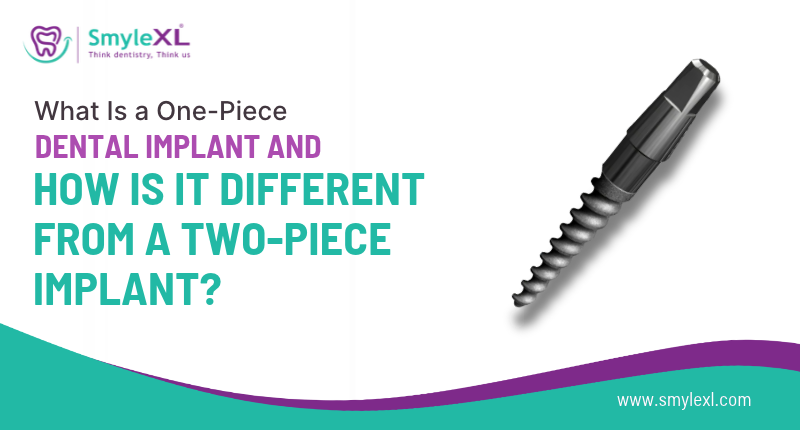

Did you know a dental implant doesn’t always have to come in two separate pieces? You might think that every implant has a screw-like post placed in the jawbone and a separate connector attached to it. But that’s not always true.
Some implants combine both parts into one single unit. This means the implant post and the connector come together as one piece!
These are called one-piece dental implants, while implants with separate components are known as two-piece implants. But how does this difference affect the treatment? At SmyleXL Dental Clinic, we help you understand the different options available for dental implant treatment in India. Let’s look at how both types work and when each may be considered.
Table of Contents
ToggleWhat Is a One-Piece Dental Implant?
Imagine getting a dental implant where the implant post and the connector are already joined together. You don’t need two separate components to form the implant structure. That’s exactly how a one-piece dental implant works!
In simple terms, it is a dental implant in which the part placed inside the jawbone and the abutment (the connector that holds the crown) are made as one continuous unit.
Here’s how its structure works:
- Implant body: The portion placed inside the jawbone that acts as an artificial tooth root.
- Integrated abutment: The connector that extends above the gum and supports the replacement crown.
Unlike conventional designs with separate components, this structure has no separate implant-abutment connection. The crown is attached to the exposed abutment after the required healing and restoration steps.
This is one of the options we may discuss when planning dental implant treatment in India at SmyleXL Dental Clinic. However, its suitability depends on your bone condition, bite, and the position of the missing tooth.
Difference Between One-Piece and Two-Piece Dental Implants
The biggest difference between these two implants is how the implant post and abutment are connected. This also affects how we position the implant and plan the final crown.
Let’s look at each difference.
1. Structure and Design
In a one-piece implant, the implant post and abutment come together as a single unit. We don’t need to attach a separate connector later.
A two-piece implant has two separate parts. The implant post goes into the jawbone, while the abutment is attached separately to hold the crown.
2. Implant Placement
With a one-piece implant, we need to be very careful about its angle during placement. Since the abutment is already attached, correcting its position later is more difficult.
With a two-piece implant, we have more flexibility. For a 1-piece implant, we fit the replacement crown onto the integrated abutment after the required healing and clinical checks. The method of crown attachment depends on the implant system and restoration design.
3. Healing Process
In a one-piece implant, the abutment usually remains above the gum during healing. We need to make sure it does not receive unwanted chewing pressure.
A two-piece implant can heal either below the gum or with a healing component visible above it. The approach depends on the treatment plan. If it heals below the gum, another minor procedure may be needed to expose it.
4. Crown Placement
For a one-piece implant, we attach the final crown to the abutment that is already part of the implant.
For a two-piece implant, we first connect the separate abutment to the implant and then fit the crown over it.
One-Piece vs Two-Piece Implants
| Feature | One-Piece Implant | Two-Piece Implant |
| Structure | Single connected unit | Two separate components |
| Abutment | Already attached | Attached separately |
| Placement | Requires careful angulation | More flexibility in abutment positioning |
| Healing | Usually has an exposed abutment | Can heal exposed or beneath the gum |
| Crown | Attached to integrated abutment | Attached to separate abutment |
| Treatment planning | Requires precise positioning | Offers more restorative flexibility |
Both designs can be used for tooth replacement. Neither is automatically better for everyone.
At SmyleXL Dental Clinic, our team will properly guide you through your case during dental implant treatment in India.
Is a One-Piece Dental Implant Possible in Every Case?
No. A one-piece design is not suitable for every missing tooth. Your jawbone condition, gum health, bite, and implant position all play a role in deciding whether this option is appropriate.
We usually consider the following factors before recommending it:
- Jawbone condition: There should be enough healthy bone to support the implant securely.
- Implant positioning: The implant needs to be placed at the correct angle because its abutment is already attached.
- Bite pressure: Excessive pressure from neighboring or opposing teeth can affect healing and implant stability.
- Gum health: Healthy gum tissue is important for supporting the implant and maintaining the surrounding tissues.
For example, if the implant needs to be placed at an angle that requires correction of the crown position, a two-piece design may offer more flexibility.
This is why we assess each case before recommending a particular single-piece dental implant or another implant design.
How Do One-Piece Implants Work?
The basic idea is simple: the implant and its connector work as one unit. However, placing it requires careful planning and the right clinical conditions.
Here’s how the process generally works:
- Dental Examination: We examine your teeth, gums, and jawbone. X-rays or a CBCT scan may be recommended to check bone availability and plan the implant position.
- Implant Placement: After planning, we place the implant into the jawbone under local anesthesia. The implant body sits inside the bone, while the attached abutment extends above the gum.
- Healing Period: The jawbone gradually bonds with the implant surface. This process is called osseointegration. During this time, we advise you to avoid unnecessary pressure on the implant.
- Crown Placement: Once healing and implant stability are confirmed, we proceed with the replacement crown. The crown is designed to fit your bite and surrounding teeth.
The process may sound straightforward, but precise implant positioning is particularly important.
Since the connector is already attached, we cannot simply change its angle later like we can with a separate abutment.
At SmyleXL Dental Clinic, we consider these factors while planning dental implant treatment in India and deciding whether a 1-piece implant is appropriate.
Is There Any Cost Difference Between One-Piece and Two-Piece Implants?
Yes, the cost may differ, but one design is not always cheaper than the other. The overall cost of dental implant treatment in India depends on:
- Implant brand and material: Different implant systems have different prices.
- Treatment complexity: Bone grafting or additional procedures may increase the cost.
- Crown material: The type of crown affects the overall expense.
- Diagnostic tests: X-rays and CBCT scans may add to the treatment cost.
A single-piece dental implant may have fewer separate components, but this doesn’t necessarily make the complete treatment cheaper.
At SmyleXL Dental Clinic, we assess your dental condition and discuss the estimated cost of dental implant treatment in India before planning the procedure. Our recommendation depends on your clinical needs and not just the implant price.
Considering Dental Implant Treatment?
If you are exploring dental implant treatment in India, the first step is understanding which implant design is suitable for your dental condition. At SmyleXL Dental Clinic, we assess your jawbone, gum health, and bite before discussing available options. Schedule a consultation with our dental team to understand the procedure, expected healing time, and estimated treatment cost.
FAQs
1. Is a one-piece dental implant better than a two-piece implant?
Not necessarily. Both designs can successfully replace missing teeth. A one-piece dental implant may be suitable when the implant can be positioned accurately, while a two-piece design offers more flexibility in adjusting the abutment.
2. How long does a single-piece dental implant take to heal?
The initial gum healing may take a few weeks, while the jawbone generally needs around 3–6 months to bond with the implant. The exact healing time depends on bone quality, implant stability, and individual healing response.
3. Is the placement of a single-piece dental implant painful?
The procedure is performed under local anesthesia, so you should not feel pain during implant placement. Some soreness, swelling, or tenderness may occur after the procedure and usually settles gradually.
4. Can a single-piece dental implant be used for front teeth?
Yes, a single-piece implant can be used for front teeth in suitable cases. However, we need to check the available bone, gum condition, and implant angle to make sure the replacement tooth fits properly and looks natural.
5. What are the limitations of one-piece dental implants?
One-piece implants offer less flexibility when adjusting the abutment angle because both parts are connected. This makes accurate implant positioning very important. They may not be suitable when the implant needs significant angulation correction.
6. How long can a one-piece dental implant last?
A one-piece dental implant can last for many years with proper care. Regular dental check-ups, good oral hygiene, and avoiding smoking can help maintain it. The crown may need replacement over time due to normal wear.