
Have you lost a few teeth but still have some natural teeth remaining? You may be considering a removable partial denture to fill those gaps. But when you explore your options, you come across different materials, including metal, acrylic, and flexible resin.
This raises a few questions. Does the material affect how comfortable the denture feels? Will a metal framework provide better support? And which option is suitable for your remaining teeth?
A removable partial denture is more than a set of artificial teeth. Its framework supports the replacement teeth and helps distribute chewing forces. At SmyleXL Dental Clinic, we consider these factors when discussing denture treatment in Phaltan. Let’s understand the different denture framework materials and how to choose between them.
Table of Contents
ToggleQuick Summary: Which Material Is Better for Partial Dentures?
- Cobalt-chromium is known for its strength and rigidity.
- Titanium offers a lightweight metallic alternative.
- PEEK provides a metal-free framework option.
- Acetal resin and nylon are flexible materials with less noticeable clasps.
- Acrylic is commonly used for conventional denture bases.
- The choice depends on your remaining teeth, bite, gum health, and treatment requirements.
What Is a Removable Partial Denture Framework?
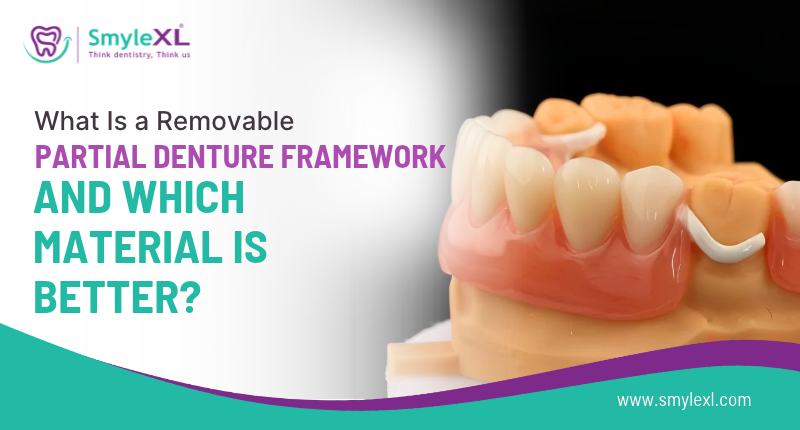
A removable partial denture (RPD) framework is the supporting structure that holds artificial teeth and helps keep the denture in position. It also helps distribute chewing forces between the remaining natural teeth and supporting oral tissues.
Think of it as the foundation of your denture.
Its main components include:
- Major connectors: Join different sections of the framework.
- Minor connectors: Connect smaller components to the main structure.
- Denture clasps: Help retain the denture by engaging selected natural teeth.
- Denture base: Supports the artificial teeth and rests against the oral tissues.
The framework’s design influences retention and stability, while appropriate support and distribution of forces help manage chewing pressure.
Depending on your dental condition, your dentist may recommend different removable partial dentures with metal, flexible, or polymer-based frameworks.
Which Materials Are Used for Removable Partial Denture Frameworks?
Different materials have different strengths and limitations. Here are four commonly considered partial denture options.
A. Cobalt-Chromium Framework
Cobalt-chromium (CoCr) is a commonly used alloy for cast partial denture frameworks.
Advantages:
- High strength and rigidity.
- Can be designed with relatively thin connectors.
- Good resistance to repeated chewing forces.
Limitations:
- Metal clasps may be visible while smiling.
- Requires careful design to avoid unnecessary stress on supporting teeth.
- May not suit patients with certain metal sensitivities.
These metal framework dentures may be considered when structural support and rigidity are important.
B. Titanium Framework
Titanium is a lightweight metallic material with good biocompatibility.
Advantages:
- Lightweight construction.
- Good biocompatibility.
- An alternative for selected patients with specific material requirements.
Limitations:
- Different strength and rigidity characteristics compared with cobalt-chromium.
- Fabrication and adjustments can be more demanding.
C. PEEK(polyetheretherketone) and Other High-Performance Polymers
PEEK is a metal-free polymer used in certain dental framework designs.
Advantages:
- Metal-free construction.
- Lightweight.
- Lower stiffness than conventional metal frameworks.
Limitations:
- May require a thicker design.
- Long-term clinical evidence is less extensive than for conventional metal frameworks.
- Repairs and adjustments may be more complicated.
D. Acetal Resin and Nylon
These thermoplastic materials are used in certain flexible denture designs.
Advantages:
- Tooth-colored or gum-colored clasps.
- Flexible construction.
- May be considered when appearance is an important preference.
Limitations:
- Lower rigidity than metal frameworks.
- Not suitable for every biting pattern or missing-tooth arrangement.
- Future modifications may be more difficult.
Flexible dentures may be considered in selected cases, but flexibility alone does not make a denture suitable for everyone.
What Is the Difference Between Metal and Flexible Partial Dentures?
The main difference is how the framework behaves during chewing and speaking.
| Feature | Metal framework | Flexible framework |
| Material | Usually cobalt-chromium or another alloy | Usually nylon or acetal resin |
| Rigidity | Higher | More flexible |
| Appearance | Metal clasps may be visible | Clasps may blend with natural teeth or gums |
| Thickness | Can be relatively thin | May require more bulk |
| Support | Suitable for appropriately designed cases | Depends on the design and clinical indication |
Both metal framework dentures and flexible dentures have different uses. The choice depends on the number and position of missing teeth, available support, and functional requirements.
How Does the Framework Affect Comfort While Eating?
A denture should remain stable when you chew, speak, and move your mouth. Three factors influence its everyday performance.
Retention and stability: Properly designed clasps and supporting components help prevent unnecessary movement.
Chewing forces: Appropriate support and distribution of forces help manage pressure across the remaining teeth and oral tissues.
Comfort: The framework’s thickness, shape, and contact with the gums influence denture comfort and fit.
A well-planned denture base design also helps distribute pressure appropriately. These factors are important during denture treatment in Phaltan, particularly when several teeth are missing.
Which Denture Framework Material Should You Choose?
There is no single material that is suitable for everyone. The choice depends on your dental condition and the purpose of the denture.
| Your requirement | Material that may be considered |
| Strength and rigidity | Cobalt-chromium |
| Lightweight metallic framework | Titanium |
| Metal-free framework | PEEK or similar polymers |
| Less noticeable clasps | Acetal resin or nylon |
| Conventional denture base | Acrylic resin |
For example, a patient with several healthy supporting teeth may have different requirements from someone with fewer remaining teeth.
Similarly, flexible dentures may suit selected cases where appearance is important, while a rigid metal framework may be considered when structural support is a priority.
At SmyleXL Dental Clinic, Phaltan, our approach to denture treatment in Phaltan considers the number of missing teeth, remaining tooth condition, bite, and oral tissues before discussing suitable options.
What Should Be Checked Before Getting a Removable Partial Denture?
Before choosing a framework, your dentist needs to understand the condition of your mouth.
The assessment may include:
- Remaining teeth: Their position, strength, and condition.
- Gum health: Whether inflammation or periodontal damage is present.
- Bite: How your upper and lower teeth meet.
- Available support: Whether the denture will rely more on teeth, gums, or both.
- Material compatibility: Whether you have known material sensitivities.
The distinction between gum-supported dentures and tooth-supported dentures is also important. Some designs receive support mainly from natural teeth, while others share support between teeth and gums.
Good oral tissue compatibility matters because the framework and denture base come into contact with the surrounding tissues.
During denture treatment in Phaltan, these findings help guide the framework selection and denture design.
How Do You Maintain a Removable Partial Denture?
Regular cleaning and careful handling help maintain your denture and the health of your remaining teeth.
Follow these habits:
- Remove and clean the denture as instructed.
- Brush your natural teeth and gums regularly.
- Clean around the clasps and areas where food collects.
- Avoid bending or adjusting the framework yourself.
- Report persistent discomfort, looseness, or irritation.
If the denture starts moving or causes sore spots, a denture adjustment may be required. Periodic reviews also help assess its condition and framework strength and durability.
Changes in your remaining teeth or gums may sometimes require denture replacement or modifications to the existing prosthesis.
Choose a Framework That Suits Your Dental Needs
A removable partial denture framework supports artificial teeth and helps manage chewing forces. Cobalt-chromium, titanium, PEEK, acetal resin, nylon, and acrylic each have different properties and limitations.
At SmyleXL Dental Clinic, we consider these differences when discussing denture treatment in Phaltan. The appropriate choice depends on your remaining teeth, gum condition, bite, and functional requirements.
Frequently Asked Questions
What is the best material for partial dentures?
There is no universally best material. Cobalt-chromium offers rigidity, titanium is lightweight, and flexible polymers may suit selected aesthetic requirements. The choice depends on your oral condition and denture design.
Are metal partial dentures better than flexible dentures?Not necessarily. Metal frameworks generally offer greater rigidity, while flexible materials may provide less noticeable clasps. Each has different indications and limitations.
Can a removable partial denture be adjusted?
Yes, certain adjustments may be possible depending on the material and framework design. A dentist should assess the denture rather than attempting adjustments at home.
How long does a removable partial denture last?
Its lifespan varies with the material, design, oral condition, and maintenance. Periodic dental evaluations help identify when adjustments or replacement may be needed.
Can I eat normally with a removable partial denture?
You may need time to adapt. Start with softer foods and gradually return to a wider variety as advised by your dentist. Chewing ability depends on the denture fitting and design.

Dr. Chetan Gundecha
Dentist & Dental Care Expert
Dr. Chetan Gundecha is an experienced dentist serving patients at SmyleXL Dental Clinic in Phaltan. He is known for his patient-focused approach and commitment to providing personalised, comprehensive dental care.
Professional Profile: Dr. Chetan Gundecha
Facebook: SmyleXL Facebook
Instagram: SmyleXL Instagram
YouTube: SmyleXL YouTube