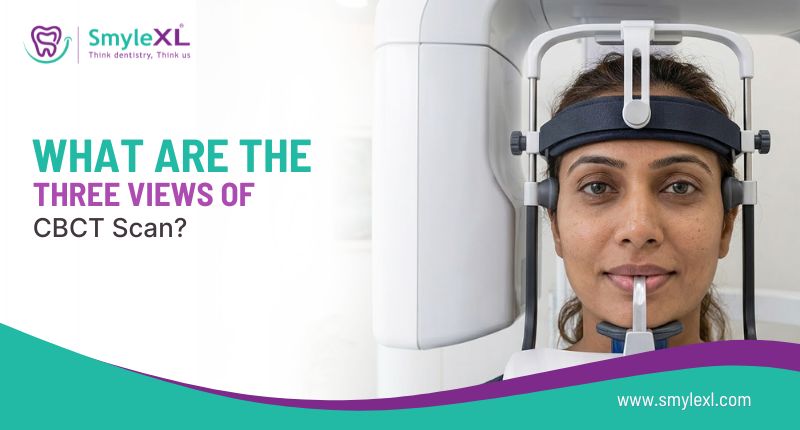

If you’ve ever visited a dentist for advanced treatment, you might have heard the term CBCT scan. Unlike regular dental X-rays, CBCT (Cone Beam Computed Tomography) gives a detailed 3D image of your teeth, jaw, and surrounding structures.
But here’s something interesting: CBCT scans don’t just give one image. They provide three different views that help dentists understand your dental condition from every angle.
If you’re considering a CBCT scan in Vijay Nagar, this blog will help you understand what these three views are, why they matter, and how they improve your dental treatment.
Table of Contents
ToggleWhat Is a CBCT Scan?
A CBCT scan is an advanced imaging technology used in dentistry to capture detailed 3D images of the teeth, bones, nerves, and soft tissues.
Unlike traditional X-rays that provide flat 2D images, CBCT scans allow dentists to view your oral structures in multiple dimensions. This helps in accurate diagnosis and better treatment planning.
Dentists often recommend CBCT scans for:
- Dental implants
- Root canal treatment
- Wisdom tooth evaluation
- Jaw disorders
- Orthodontic planning
At SmyleXL Dental Clinic, CBCT technology helps ensure precise and safe dental treatments.
Why Are Multiple Views Important?
Imagine trying to understand a building by looking at it from just one side, it would be incomplete, right?
Similarly, a single image of your teeth cannot provide complete information. Dentists need to see your teeth from different angles to understand depth, position, and structure.
This is where the three views of the CBCT scan come into play.
These views help dentists:
- Detect hidden problems
- Plan treatments accurately
- Avoid complications
- Improve treatment outcomes
The Three Views of a CBCT Scan
- Axial View (Top View)
The axial view shows a horizontal view of your teeth and jaw, as if you are looking from the top down.
What Does It Show?
- Shape and position of teeth
- Bone structure
- Jaw alignment
- Relationship between teeth
Why Is It Important?
This view helps dentists understand how teeth are positioned relative to each other. It is especially useful for:
- Evaluating impacted teeth
- Planning dental implants
- Checking bone thickness
It gives a clear idea of how everything is arranged inside your mouth.
- Coronal View (Front View)
The coronal view shows a vertical view from front to back, similar to looking directly at your face.
What Does It Show?
- Height of teeth
- Jawbone structure
- Sinus position
- Gum and bone levels
Why Is It Important?
This view helps dentists assess the vertical structure of the teeth and surrounding bone.
It is particularly useful for:
- Detecting bone loss
- Evaluating sinus proximity
- Planning orthodontic treatments
The coronal view gives a clear understanding of how tall and aligned your teeth and jaw structures are.
- Sagittal View (Side View)
The sagittal view shows a side profile of your teeth and jaw.
What Does It Show?
- Depth of teeth
- Bite alignment
- Jaw position
- Tooth roots
Why Is It Important?
This view helps dentists understand the relationship between upper and lower teeth.
It is commonly used for:
- Root canal planning
- Orthodontic treatment
- Jaw alignment analysis
The sagittal view is essential for understanding how your bite works.
How These Three Views Work Together?
Each CBCT view provides a different perspective, but when combined, they give a complete 3D understanding of your oral health.
Think of it like solving a puzzle, each piece adds more clarity. Together, these views help dentists:
- Identify problems early
- Plan precise treatments
- Reduce risks during procedures
- Improve long-term results
This is why CBCT scans are considered one of the most advanced diagnostic tools in modern dentistry.
When Do You Need A CBCT Scan?
A dentist may recommend a CBCT scan in several situations.
Some common cases include:
- Before dental implant placement
- For complex root canal treatments
- To evaluate impacted wisdom teeth
- For jaw pain or TMJ issues
- For orthodontic planning
CBCT scans are especially useful when detailed imaging is required.
Is a CBCT Scan Safe?
Yes, CBCT scans are considered safe. They use a focused beam of radiation, which means exposure is lower compared to traditional CT scans.
Dentists only recommend CBCT scans when necessary, ensuring patient safety while obtaining accurate diagnostic information.
Benefits of CBCT Scan for Patients
CBCT scans offer several advantages that improve the overall dental experience.
- Accurate diagnosis
- Better treatment planning
- Reduced treatment time
- Improved safety during procedures
- Higher success rates
At SmyleXL Dental Clinic, patients who undergo a CBCT scan in Vijay Nagar often benefit from more predictable and efficient dental treatments.
Why Choose SmyleXL Dental Clinic For CBCT Scan in Vijay Nagar?
At SmyleXL Dental Clinic, advanced CBCT technology is used to ensure precise diagnosis and treatment planning.
The clinic focuses on providing patient-friendly care with modern equipment and experienced dental professionals.
Whether it’s implants, root canals, or orthodontics, CBCT scans help deliver better outcomes and improved comfort.
Why CBCT Is a Game-Changer in Dental Care?
Understanding the three views of a CBCT scan, axial, coronal, and sagittal, helps you appreciate how modern dentistry works behind the scenes.
These views allow dentists to see your teeth and jaw from every angle, ensuring accurate diagnosis and effective treatment planning.
If your dentist recommends a CBCT scan in Vijay Nagar, it’s because they want the best possible understanding of your dental condition.
At SmyleXL Dental Clinic, advanced imaging technology ensures that every treatment is planned with precision, helping you achieve a healthier and more confident smile.
FAQs
1. What are the three views in a CBCT scan?
The three views are axial (top view), coronal (front view), and sagittal (side view). Together, they provide a complete 3D understanding of your teeth and jaw.
2. Why is CBCT better than a regular dental X-ray?
CBCT provides detailed 3D images, while regular X-rays show only 2D images. This allows dentists to detect problems more accurately and plan treatments more effectively.
3. How long does a CBCT scan take?
A CBCT scan is quick and usually takes less than a minute to capture images, making it a fast and comfortable procedure for patients.
- Do I need a CBCT scan in a dental emergency?
In some dental emergencies, such as severe tooth pain, facial swelling, trauma, or suspected infection, a CBCT scan may be recommended. It helps the dentist quickly identify the exact problem, such as hidden infections, fractures, or nerve involvement, allowing for faster and more accurate treatment.
5. Can a CBCT scan detect serious infections immediately?
Yes, a CBCT scan can detect infections, abscesses, and bone damage in detail, even when they are not visible on regular X-rays. This is especially important in emergencies, as it helps the dentist plan immediate treatment and prevent the infection from spreading further.