
Bleeding gums while brushing is so common that most people have quietly decided it’s just how their gums are. The toothbrush comes away pink, they rinse, and they move on with their morning. It’s become as routine as the chai that follows. What nobody mentions is that healthy gums don’t bleed. Not during brushing, not during flossing, not at all. The bleeding is the gum’s way of raising its hand and saying something is wrong, and most of us have been ignoring that hand for years.
The moment a dentist says “gum disease,” the mind immediately jumps to surgery, stitches, and a recovery that sounds deeply unpleasant. At SmyleXL Dental Clinic, patients who come in looking into gum treatment in Lal Darwaja, Surat are often relieved to find that the answer to whether surgery is necessary is more nuanced than they expected.
Table of Contents
ToggleGum Disease Is Not One Thing
This is where most of the confusion starts. Gum disease is not a single condition with a single treatment. It exists on a spectrum, and where a patient sits on that spectrum determines everything about what’s needed to address it.
The two main stages are gingivitis and periodontitis, and the difference between them is crucial for treatment options.
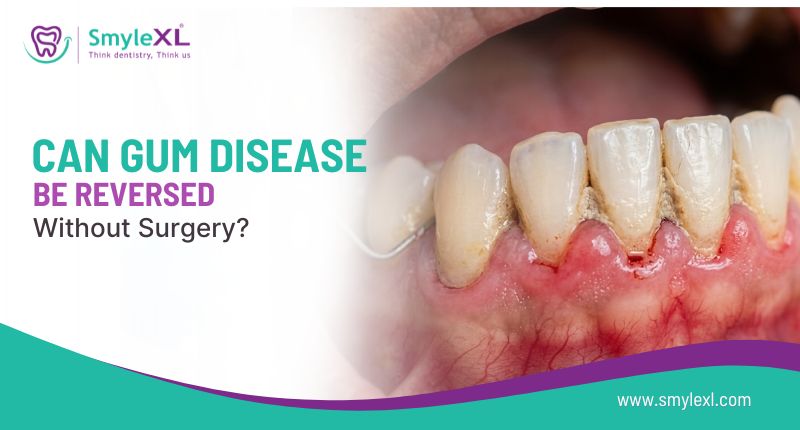
Gingivitis is the early stage. The gums are inflamed, they bleed easily, and they may look redder or slightly swollen. But at this point, the damage is limited to the gum tissue itself. The bone and the ligaments holding the teeth in place are not yet affected.
Periodontitis is what gingivitis becomes when it’s left unaddressed. The infection moves deeper. The bone supporting the teeth begins to break down. Pockets form between the gum and the tooth, creating space where bacteria accumulate and the damage compounds.
The reason this distinction matters is straightforward: gingivitis is fully reversible. Periodontitis, once established, is manageable but not reversible in the same way. The bone that’s lost does not grow back on its own. What treatment achieves at that stage is halting the progression and stabilising what remains.
What Reversing Early Gum Disease Actually Involves
For patients with gingivitis, the path to reversal is genuinely achievable without surgery and without anything dramatic. What it does require is consistency and a willingness to take the home care side seriously.
Professional treatment at this stage typically includes:
- A thorough scaling to remove tartar buildup from the teeth and just below the gumline
- Polishing to clear surface plaque and smooth the tooth
- An assessment of the depth of the gum pockets around each tooth
- Guidance on brushing technique, because how you brush matters as much as whether you brush
The home care component is not optional. Professional cleaning removes what has already accumulated. Daily brushing and flossing prevent it from rebuilding at the same rate. Without both working together, the gums stay inflamed, and the condition doesn’t improve, regardless of how good the clinical treatment is.
Most patients with gingivitis see a significant improvement within four to six weeks of consistent treatment and proper home care. The gums firm up, the bleeding reduces and eventually stops, and the redness settles. That reversal is real, and it’s lasting, provided the habits are maintained.
When the Disease Has Gone Further
For patients who come in with periodontitis, the approach is more involved, but surgery is still not the automatic first response. Non-surgical treatment is the starting point for most cases of mild to moderate periodontitis, and it produces meaningful results for a large proportion of patients.
The primary non-surgical treatment for periodontitis is scaling and root planing, sometimes called a deep clean. It covers the same ground as a standard scale but goes further below the gumline to clean the root surfaces of the teeth where bacteria have settled into the pockets.
What this achieves:
- Removes bacterial deposits from root surfaces that are driving the infection
- Reduces pocket depth as the gums heal and tighten around the cleaned tooth
- Significantly slows the progression of bone loss
- Creates conditions where the immune system can manage residual bacteria more effectively
This is carried out under local anaesthesia, so the procedure itself is comfortable. The area may be tender for a few days afterward, and some patients experience temporary sensitivity in the treated teeth. Both settle relatively quickly.
Follow-up appointments four to six weeks after treatment allow us to measure whether the pockets have reduced and assess whether the response has been sufficient. For many patients, it has been. For those with deeper pockets or more advanced bone loss, surgery may then be discussed as the next step, but it comes after non-surgical treatment has been given a proper chance, not as the first option.
The Factors That Affect How Well Treatment Works
Two patients with identical levels of gum disease can respond differently to the same treatment. Several factors influence this, and we discuss them openly with patients at SmyleXL Dental Clinic because managing them is part of managing the condition.
Smoking significantly impairs the healing response in gum tissue. Patients who smoke see slower improvement and higher rates of recurrence. Reduction or cessation makes a measurable difference to treatment outcomes.
Diabetes affects how the body responds to infection, including in the gums. Patients with poorly controlled blood sugar tend to have more aggressive gum disease and respond less predictably to treatment. Better blood sugar management directly supports gum healing.
Stress affects immune function and can increase inflammatory responses throughout the body, including the gums. It also tends to reduce compliance with home care routines.
Genetics plays a role in some patients who develop significant gum disease despite good oral hygiene. These patients need more frequent professional maintenance rather than a different philosophy of treatment.
None of these factors makes treatment pointless. They make managing them part of the treatment.
What Maintenance Looks Like After Treatment
Gum disease, once it has reached periodontitis, requires ongoing monitoring. The condition can be stable for years with proper care, and it can reactivate if care lapses. This is not a reason for alarm. It’s just the nature of the condition and one we’re upfront about from the beginning.
Maintenance visits for patients who have had periodontitis treatment happen every three to four months rather than the standard six. These visits include:
- Re-measurement of pocket depths to track stability
- Removal of any new buildup before it can restart the cycle
- Assessment of home care and adjustment of technique where needed
- Early identification of any area showing signs of reactivation
The goal of gum treatment in Lal Darwaja Surat at our clinic is not just to get through the initial treatment. It’s to keep patients stable long-term, with as little intervention as possible over time.
Gums That Have Been Ignored Long Enough
The patients we see at SmyleXL Dental Clinic who respond best to gum treatment are not the ones with the mildest disease. They’re the ones who take the home care instructions seriously and come back for their follow-up appointments.
Gum disease in its early stages is one of the most treatable conditions in dentistry. In its later stages it’s manageable in a way that protects the teeth for years. In both cases, doing something about it is better than waiting, and surgery is rarely the first conversation when the problem is caught and addressed properly.
If your gums have been trying to tell you something for a while, it’s worth listening. We offer gum treatment in Lal Darwaja, Surat, and the first step is simply coming in to understand where things stand.