
That smooth, squeaky-clean feeling right after a dental cleaning, where your tongue keeps running over your teeth because they feel like a different set entirely. It lasts about a day before chai, rajma chawal, and life in general get back to work on them. But on that one day, you genuinely understand why dentists keep asking you to come in more often.
Most patients sit through the whole cleaning appointment without knowing whether what just happened was scaling, polishing, or both. The dentist moves from one instrument to another, there’s some vibrating, some brushing, some gritty paste, and then it’s done. Nobody explains the difference because everyone assumes the other person already knows. At SmyleXL Dental Clinic, where teeth cleaning in Ashiyana, Lucknow is one of the most common procedures we do, we’ve decided to just say it plainly.
Table of Contents
ToggleTwo Procedures, Two Completely Different Problems They Solve
Scaling and polishing are almost always done together in the same appointment, which is why most patients assume they’re the same thing. They’re not. They address different problems, use different instruments, and serve different purposes for your teeth.
Scaling targets what’s underneath. Polishing targets what’s on top. One removes a hard, mineralised deposit that brushing physically cannot touch. The other removes surface stains and smooths the tooth to slow down future buildup. Both matter, and understanding what each one does changes how you think about your overall dental hygiene.
What Scaling Actually Does
Tartar, also called calculus, is what happens when plaque, the soft sticky film that forms on teeth after eating, is not removed consistently. Over time, plaque absorbs minerals from saliva and hardens into a deposit that bonds to the tooth surface. Once that happens, no toothbrush, no matter how expensive or how aggressively you use it, will remove it.
Scaling is the process of removing this hardened deposit from the teeth and from just below the gumline, where it tends to accumulate quietly.
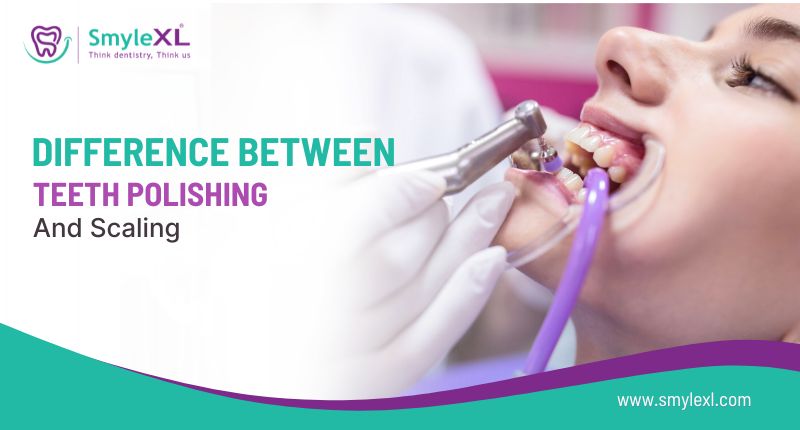
The instrument most commonly used is an ultrasonic scaler, a device that uses high-frequency vibrations and a fine mist of water to break up and flush away tartar. Patients often describe it as a light tickling vibration or mild pressure on the teeth. For patients with significant buildup near the gums, some sensitivity is normal during the procedure.
What scaling addresses:
- Tartar deposits on the visible surface of teeth
- Buildup along the gumline where toothbrush bristles don’t reach effectively
- Deposits in the spaces between teeth
- Calculus below the gumline in patients with early gum disease
Left unaddressed, tartar buildup leads directly to gum inflammation, gum recession, and, over time, bone loss around the teeth. Scaling isn’t cosmetic. It’s preventive in the truest sense.
What Polishing Does and Why It Comes After
Once scaling is complete and the tartar is gone, the tooth surface is clean but not smooth. Polishing comes next, and its job is to address what’s sitting on the surface itself rather than bonded to it.
A rotating rubber cup or brush is used with a mildly abrasive paste to buff the outer surface of each tooth. This removes:
- Surface staining from tea, coffee, and food
- Residual plaque that scaling loosened but didn’t fully clear
- Minor discolouration on the enamel surface
The gritty paste used during polishing is often what patients remember most about a cleaning appointment, along with that squeaky feeling immediately after. The smoothness isn’t just satisfying. A polished tooth surface is physically harder for plaque to adhere to, which slows down the rate at which tartar starts forming again.
Polishing is primarily aesthetic in benefit compared to scaling, but that doesn’t make it optional. It’s the finishing step that makes the cleaning complete and gives teeth the best possible starting point between visits.
How Often Should You Be Getting Both Done
This is where we have a slightly different conversation with different patients, because the honest answer is that it depends.
For patients with healthy gums and a consistent home care routine, professional cleaning every six months is generally sufficient. For patients with a history of gum disease, heavy buildup, or conditions like diabetes that affect gum health, we typically recommend every three to four months.
What drives the frequency is not how long it’s been since your last visit, but how quickly tartar accumulates on your specific teeth. Some people build up significant deposits in three months. Others are relatively slow accumulators. We assess this during every visit and adjust the recommendation accordingly.
What doesn’t change regardless of frequency:
- Brushing twice daily with a fluoride toothpaste
- Cleaning between teeth with floss or an interdental brush
- Limiting sugary and acidic food and drink, especially between meals
- Not skipping the scheduled professional cleaning because nothing feels wrong
Nothing feeling wrong is not the same as nothing being wrong. Tartar below the gumline causes no pain in early stages, which is precisely why it progresses undetected in patients who only visit when something hurts.
Does It Hurt and Is There Anything to Be Worried About
This is the question we get most often, and we prefer to answer it directly rather than offer blanket reassurance.
For patients with healthy gums and mild buildup, scaling is comfortable. There may be some sensitivity during the procedure, particularly near the gumline, but it’s generally well-tolerated without any anaesthesia.
For patients who haven’t had a cleaning in a long time, or those with inflamed gums, the experience can be more sensitive. Inflamed gum tissue bleeds more easily and responds more sharply to contact. This is not a reason to avoid the procedure. It’s actually a reason the procedure is more necessary. After regular cleanings, as gum health improves, the sensitivity reduces significantly.
A few things patients sometimes worry about that aren’t actually a concern:
- Scaling does not damage enamel when done correctly with proper instruments
- The sensitivity some patients feel after a cleaning typically resolves within a day or two
- Teeth feeling looser after a deep clean is a temporary sensation caused by tartar removal, not actual loosening
Let’s Make Teeth Cleaning A Routine
For anyone coming to us for teeth cleaning in Ashiyana Lucknow, the appointment itself is thirty to forty-five minutes. What happens in the other roughly eight thousand hours before the next one is what actually determines how much work we have to do when you’re back in the chair.
We tell every patient the same thing: the cleaning we do removes what your routine missed. The routine you maintain at home determines how much gets missed. Both matter equally, and neither replaces the other.
When a Cleaning Becomes More Than Just a Cleaning
Patients who come to us regularly for teeth cleaning in Ashiyana, Lucknow, often find that the cleaning appointment catches other things early. A new cavity forming between teeth. A gum pocket that’s deepened slightly. A small crack on a back tooth that hasn’t caused pain yet, but will.
Early detection is one of the less talked-about benefits of consistent professional cleaning. The cleaning brings you in. The examination during that visit finds things that wouldn’t surface until they became bigger problems.
At SmyleXL Dental Clinic, we treat a routine cleaning as a complete visit, not a quick polish and goodbye. If something needs attention, we’ll tell you during the same appointment, before it turns into the kind of problem that needs a longer, more involved conversation.