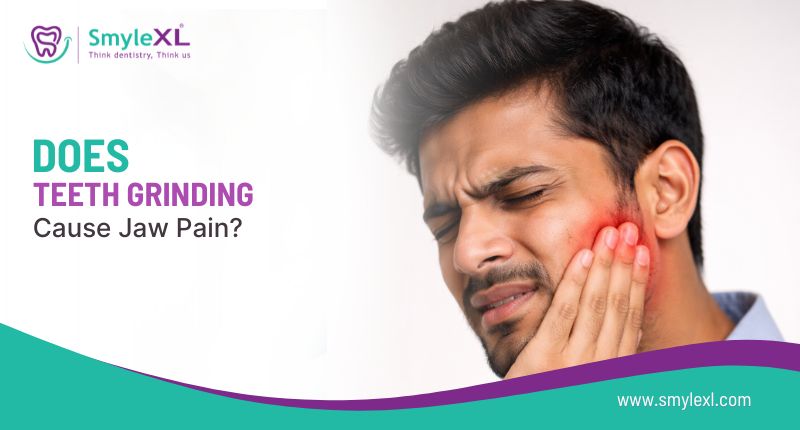

You wake up, and your jaw is already tired. Not sore enough to be dramatic about, just that low, familiar tightness that takes an hour and two cups of chai to loosen up. It’s become such a normal part of the morning that you’ve stopped registering it as a symptom and started treating it as just how mornings are.
That shift, from “something’s wrong” to “this is just how it is,” is exactly how teeth grinding stays undetected for years. At SmyleXL Dental Clinic, jaw pain is one of the most under-reported things we treat, mostly because patients have quietly made peace with it long before looking into jaw pain treatment in Nashik Road, Nashik.
Table of Contents
ToggleWhat Teeth Grinding Actually Is and Why It Happens at Night
Bruxism is the clinical term for teeth grinding or jaw clenching, but what it feels like in daily life is your jaw working overtime while the rest of you is completely unaware. Most people who grind their teeth do it during sleep, which is precisely why it goes unnoticed for so long. There’s no conscious moment where you decide to clench. It just happens, repeatedly, through the night.
The triggers vary from person to person:
- Stress and unresolved anxiety are the most common drivers
- Sleep disorders, particularly obstructive sleep apnea, are closely linked to bruxism
- Misaligned teeth or an uneven bite creates muscle imbalance that leads to teeth grinding
- Certain medications, including some antidepressants, can increase the tendency
- Caffeine and alcohol, particularly in the evening, affect sleep quality and increase teeth grinding
What’s worth understanding is that teeth grinding is rarely just one thing. Most patients we see have a combination of factors at play, and addressing only one while ignoring the others is why the problem persists for so many people.
The Connection Between Grinding and Jaw Pain
The jaw joint is called the temporomandibular joint, or TMJ. It sits just in front of each ear and is responsible for every movement your mouth makes, opening, closing, chewing, and speaking. It is one of the most used joints in the body, and it is also one of the most sensitive to sustained pressure.
When teeth grinding happens repeatedly, the muscles around the jaw are contracting for hours at a time without rest. The joint itself absorbs force that it was never designed to handle consistently. Over time, this produces:
- A consistent dull ache in the jaw, particularly noticeable in the morning
- Pain that radiates into the temples, ears, and sometimes the neck
- A clicking or popping sound when opening or closing the mouth
- Difficulty opening the mouth fully, especially after waking
- Headaches that begin at the temples and feel worse before noon
The frustrating part for many patients is that jaw pain from grinding doesn’t always appear immediately. It builds gradually, which is why by the time someone looks into jaw pain treatment in Nashik Road, Nashik, the teeth grinding has often been going on for a year or more without being identified as the cause.
What Your Teeth Are Telling You in the Meantime
While the jaw bears the force of grinding, the teeth record it. When we examine a patient who grinds their teeth, the evidence is usually visible before they’ve said a word about jaw pain.
Signs we look for during examination:
- Flattened or worn biting surfaces on the back teeth
- Chipping or cracking along the edges of front teeth
- Increased tooth sensitivity from enamel loss
- Indentations along the inner cheek where teeth have been pressed repeatedly
- Scalloped edges along the sides of the tongue from pressure against the teeth
These changes happen slowly, which is another reason bruxism stays under the radar. Patients adapt to the sensitivity, chalk up the wear to normal ageing, and don’t connect it to the jaw pain they’ve been managing with painkillers on and off for months.
How We Assess and Diagnose the Problem
When a patient comes to us with concerning jaw pain, we don’t assume bruxism and move on. Several conditions produce similar symptoms, like TMJ disorders unrelated to grinding, sinus issues, ear problems, and referred pain from the neck. A thorough assessment separates these concerns effectively.
Our approach includes:
- A detailed conversation about when the pain occurs, what makes it worse, and what the sleep and stress look like
- Clinical examination of the jaw joint, the bite, and the muscles around the jaw
- Assessment of tooth wear patterns and any visible damage
- X-rays are needed to evaluate the joint and the surrounding bone structure
- In some cases, referral for a sleep study if sleep apnea is suspected as a contributing factor
The diagnosis shapes the treatment plan. A patient with mild bruxism driven primarily by stress needs a different approach than a patient with significant joint damage and an underlying sleep disorder.
Treatment: What Actually Helps
Managing bruxism and the jaw pain it causes involves more than one line of treatment, and we’re honest about that with every patient.
Night guards are usually the first intervention. A custom-fitted oral splint worn during sleep creates a protective barrier between the upper and lower teeth, absorbs grinding force, and reduces the load on the jaw joint. It doesn’t stop the grinding habit, but it significantly limits the damage and gives the jaw muscles a chance to recover.
Physiotherapy and jaw exercises help with muscle tension and joint stiffness. We guide patients through specific movements that release tightness and improve the range of motion over time.
Bite correction is considered when uneven tooth contact is contributing to the grinding pattern. This might involve adjusting specific teeth or, in more involved cases, orthodontic treatment.
Stress management is part of the picture for most patients. We discuss this openly because ignoring it means the grinding continues even with a night guard in place.
Botox injections into the masseter muscle are an option for severe cases where muscle hyperactivity is causing significant pain. This relaxes the grinding muscles without affecting normal chewing function and provides relief that other treatments alone sometimes can’t achieve.
Jaw Pain That Has Been There Long Enough
Patients who come to us for jaw pain treatment in Nashik Road, Nashik, often describe the same arc: months of vague discomfort, self-diagnosis as stress, a few rounds of painkillers, and eventually a moment where the pain is bad enough to prompt a proper visit.
That visit usually brings clarity quickly. The cause becomes identifiable, the treatment path becomes clear, and the relief, once the right intervention is in place, is significant.
At SmyleXL Dental Clinic, jaw pain is something we take seriously from the first appointment. If your jaw has been clicking, aching, or making its presence known every morning, it’s telling you something worth listening to. The sooner that conversation happens with a dentist who knows what to look for, the less time you spend managing pain that is genuinely treatable.