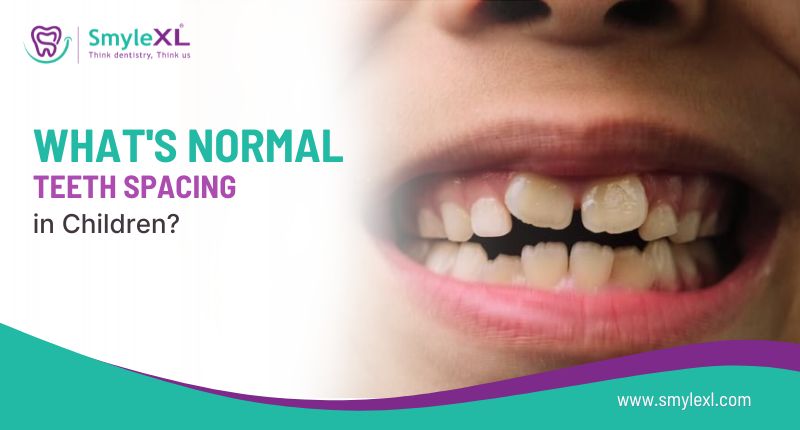

If your child is between 7 and 9 years old and you have noticed their front teeth coming in wide-set, gappy, and slightly splayed out, you are not looking at a dental problem. You are watching a completely normal stage of development that dentists call the “ugly duckling stage”. The neat little milk-tooth smile you remember is being replaced by something that looks temporarily awkward, and most parents find it alarming. It is not.
At SmyleXL Dental Clinic, we see this at almost every school-age check-up. The parents who understand what is happening stop worrying and instead get to watch the remarkable transformation that follows. This is also the age when kids dental treatment in Chitradurga becomes part of a family routine.
Table of Contents
ToggleWhy Gaps in Baby Teeth Are Actually a Good Sign
This surprises most parents. A normal gap in toddler teeth is not something to worry about, and it is one of the first things we explain during kids dental treatment in Chitradurga consultations. Those spaces are doing an important job.
Milk teeth spacing exists by design. Baby teeth are smaller than the permanent teeth replacing them, so the gap between baby teeth reserves space for what is coming. Tightly packed baby teeth with no spacing carry a higher crowding risk.
| Spacing in Baby Teeth | What It Means |
| Small gaps between all teeth | Normal, healthy |
| No spacing at all | Worth monitoring for crowding |
| Very large or uneven gaps | Worth mentioning at a check-up |
Primary teeth spacing is something we assess at every early visit, and it forms the baseline for all dental treatment for kids that follows.
The Ugly Duckling Stage: What Is Actually Happening
Between ages 7 and 9, the upper permanent incisors arrive wider than the baby teeth they replace. The unerupted canines waiting below the gums push them slightly outward, creating the wide-set, gappy appearance that defines this phase.
What you will typically see:
- A noticeable front teeth gap between the two upper central incisors
- Teeth that look fanned outward
- A smile that looks very different from a year ago
- Sometimes a slight overlap or crowding on the sides
This is a diastema in kids, but it doesn’t need treatment. This is child teeth development doing exactly what it should. As the canine teeth come through, they push the front teeth together, and the gap closes naturally, usually by age 11 or 12.
We always explain this to parents at check-ups because the number of families who come in convinced their child needs braces immediately, only to discover everything is on track, is genuinely high. Understanding child teeth development saves a lot of unnecessary worry.
Primate Spaces: The Gap Nobody Talks About
Child primate spaces sit next to the canines in young children and look deliberate enough that parents often ask. In the upper jaw, the space is just in front of the canine; in the lower jaw, just behind it.
These gaps are so expected that their absence raises a flag, not their presence. They close on their own. When parents notice them during their visit for kids dental treatment in Chitradurga, we reassure them straight away.
When a Gap Is Worth Looking At More Closely
Most teeth gap in children resolve on their own. But a few situations call for a closer look or an early orthodontic assessment.
Gaps that may need attention:
- A frenum gap teeth situation where the frenulum is thick and low
- A gap persists past age 12 or 13
- A gap is growing wider rather than stable
- Missing teeth on X-ray affecting spacing
- Crowding vs spacing issues forming on both sides
A frenum gap is the most common reason a front gap does not close. We check for this routinely as part of the kids dental treatment in Chitradurga, which we provide. If the frenulum is the cause, a small frenectomy done before orthodontic treatment gives the gap a chance to close naturally.
Child Tooth Eruption Order and What to Expect
Child tooth eruption order follows a fairly predictable pattern, though every child runs on a slightly different timeline. Knowing it helps parents understand what each visit is watching for.
Typical eruption sequence:
- 6 to 7: Lower central incisors, first permanent molars
- 7 to 8: Upper central incisors (gap-prone phase)
- 8 to 9: Lateral incisors
- 9 to 11: Canines and first premolars
- 11 to 13: Second premolars, second molars
During each phase, teeth alignment shifts as gaps open and close again. Families we see for kids dental treatment in Chitradurga during these years watch this process unfold firsthand.
Here Is What Is Considered Normal At Each Age
| Age | What You Will See | Is It Normal? |
| 1 to 3 years | Small gaps between all baby teeth | Yes, completely normal |
| 4 to 6 years | Natural spaces next to the canines | Yes, expected and healthy |
| 7 to 9 years | Wide front gap, teeth look splayed | Yes, the ugly duckling stage |
| 10 to 12 years | The front gap is gradually closing | Yes, canines are doing their job |
| 13 years and above | Front gap is still there | Worth a check-up |
What Early Childhood Dental Care Actually Looks Like
Early childhood dental care is mostly monitoring, and it is the foundation of basic children’s dental care.
A standard pediatric oral care visit for kids dental treatment in Chitradurga at SmyleXL includes:
- Checking overall arch development and spacing
- Assessing eruption progress against the expected timeline
- Identifying any spacing concerns worth monitoring
- Reviewing brushing, diet, and habits for child dental health
- Recommending an orthodontic review where relevant
Kids dental treatment in Chitradurga at SmyleXL Dental Clinic follows this principle: assess early, monitor consistently, act only when needed.
When to See a Pediatric Dentist
Book a check-up if:
- No teeth by 6 to 8 months old
- A tooth has been lost early and milk tooth treatment is needed
- A permanent tooth is erupting behind, not replacing, a baby tooth
- The upper front gap is growing wider after age 10
- Canines still have not come through by age 13
- Thumb sucking or tongue thrusting is affecting spacing
Early milk tooth treatment matters more than many parents realise. We emphasise this in every kids dental treatment in Chitradurga consultation. Losing a baby tooth too soon causes neighbouring teeth to drift, reducing space for the incoming permanent tooth.
Frequently Asked Questions
Is a gap between my child’s front teeth something to worry about?
In most cases, a front teeth gap in children between 7 and 10 is completely normal and part of this developmental phase. The canine teeth gradually close this gap as they come through. If it persists past 12 or 13, or appears to widen, a child orthodontic review with a pediatric dentist is a sensible next step.
Do baby teeth gaps mean my child will have crooked adult teeth?
Not at all. Milk teeth spacing and baby teeth gap are signs of healthy child teeth development, not predictors of a crooked adult smile. Tightly packed baby teeth are actually more likely to lead to crowding later. Pediatric oral care visits help us track this over time.
What is the ugly duckling stage, and when does it end?
This phase is the period, usually between 7 and 9 years, when upper permanent incisors emerge wide-set and gappy before the canines push them together. It typically resolves naturally between ages 11 and 12 without any intervention. Early childhood dental care visits during this time are about monitoring, not treating.
My child lost a baby tooth early. Does that affect spacing?
Yes, and it is one of the main reasons early milk tooth treatment matters. When a baby tooth is lost too soon, neighboring teeth drift and reduce space for the permanent tooth. A child dentist may recommend a space maintainer to preserve the correct spacing.
At what age should I start taking my child to a dentist?
We recommend visiting a child dentist around the time the first tooth appears, or by age one at the latest. Child dental care from an early age builds familiarity, makes check-ups easier as children grow, and ensures primary teeth spacing and development are tracked from the beginning. A pediatric dentist will guide you on cleaning techniques, diet, and when early orthodontic assessment might be relevant.
Development Is Messy. That Is How It Is Supposed to Be.
Watching your child’s smile change can feel unsettling, especially when gaps seem to appear overnight. But the mouth has its own timeline, and most of what parents worry about during these years resolves on its own.
What we focus on at SmyleXL Dental Clinic is making sure nothing gets missed. Regular early childhood dental care visits support long-term child dental health and mean we are tracking development alongside you, not stepping in only when something has gone wrong. Kids dental treatment in Chitradurga at our clinic starts early and keeps your child comfortable in the dental chair long before any treatment is needed.