
Have you noticed a black or gray line appearing around your dental crown? Perhaps the gums near one tooth look darker than the surrounding tissue. You may wonder whether the crown is causing this change or whether something is wrong with the tooth underneath.
Dark gums around dental crowns can have several explanations. The metal edge of an older crown may become visible, or the appearance may be related to gum recession, tooth discoloration, or inflammation. Identifying the cause is important because each problem may need a different approach.
At SmyleXL Dental Clinic, we consider the gums, existing restoration, and underlying tooth when discussing gum treatment in Salisbury Park. Here are the possible reasons for discoloration and what can be done about them.
Table of Contents
ToggleQuick Summary: Why Do Gums Turn Dark Around Dental Crowns?
- Older porcelain-fused-to-metal crowns may show a dark margin near the gums.
- Gum recession can expose the metal edge or natural tooth root.
- A previously root-canal-treated tooth may darken and create a shadow near the gumline.
- Plaque buildup, decay, and gum inflammation can affect the surrounding tissue.
- Treatment depends on the cause and may involve gum care, restoration repair, or crown replacement.
Why Are My Gums Darkened Around My Crown?
A dark appearance around a dental crown does not always mean that your gums are unhealthy. Gum discoloration may come from the crown material, changes in gum tissue, or the tooth underneath.
Visible Metal Margins Around the Crown
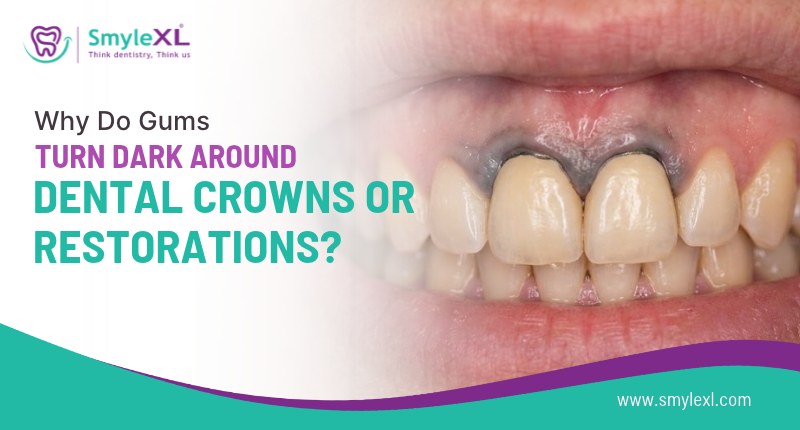
Some porcelain-fused-to-metal (PFM) crowns have a metal base covered with tooth-colored porcelain. The metal edge may sit close to or slightly beneath the gumline. If the gums move away over time, this edge can become visible as a gray or black line.
This is one possible reason for a dark line around a crown. The visibility of the metal edge, or Crown margin visibility, depends on the crown design and surrounding gum position. These Soft tissue changes can make a previously hidden margin more noticeable.
Gum Recession Around the Crown
Gums may gradually move away from a tooth due to periodontal problems, brushing habits, or other local factors. This is called Gingival recession. Around a crown, recession may expose its metal margin or the natural root underneath.
Exposed tooth roots can look yellowish or brownish rather than black. Recession can also make the crown edge more noticeable and affect the appearance of your smile.
Darkening of the Tooth Underneath
A tooth that has undergone root canal treatment can sometimes become darker over time. If the surrounding gum tissue is thin, the underlying discoloration may create a shadow near the gumline.
This differs from Localized gum pigmentation, which is a change in the color of the gum tissue itself.
Decay or Infection Around the Crown
The edge where the crown meets the natural tooth is called the crown margin. Plaque and bacteria collecting around this area may contribute to decay or Gum inflammation.
Other signs can include:
- Red or swollen gums.
- Bleeding while brushing.
- Tenderness around the restoration.
- An unpleasant taste or persistent discomfort.
These crown-related gum problems need attention because discoloration accompanied by inflammation may indicate an underlying dental concern. Ongoing Gum tissue irritation can also occur if plaque collects around the restoration or its fit is unsuitable.
If you’re considering Gum Treatment in Salisbury Park, identifying whether the problem comes from the gums or the crown itself is an important first step.
Why Is There a Black Line Forming Around My Crown?
A dark line around a crown may be caused by a visible metal margin, particularly if the gums have receded. It can also be related to changes in gum position, darkening of the underlying tooth, buildup around the crown margin, or decay near the restoration.
The appearance alone cannot confirm the cause. A Dental examination helps the dentist assess the crown margin, surrounding gum tissue, and underlying tooth. They may also check Crown margin visibility before deciding whether treatment is needed.
At SmyleXL Dental Clinic, we consider these findings when discussing Gum Treatment in Salisbury Park, rather than assuming that every dark line requires crown replacement.
How Do I Get Rid of the Black Around My Crown?
The right approach depends on what is causing the discoloration. Cleaning the visible area may help if plaque is contributing to the problem, but it will not change a metal edge showing through the gums or correct gum recession.
| Possible cause | What may be considered |
| Visible metal margin | Assess whether crown replacement with a suitable metal-free restoration is appropriate |
| Gum recession | Evaluate gum health and discuss periodontal care |
| Darkened underlying tooth | Examine the tooth and existing restoration |
| Plaque buildup and inflammation | Professional cleaning and improved oral hygiene |
| Decay near the crown | Assess the affected tooth and plan restorative care |
If the dark line comes from a visible metal margin, Gum Treatment alone may not remove it. Crown replacement may be considered if the existing restoration needs to be changed.
On the other hand, gum pigmentation treatment may not be appropriate if the actual concern is gum disease rather than pigmentation.
At SmyleXL Dental Clinic, we consider the underlying cause before discussing Gum treatment options. Depending on the findings, Dental crown treatment may also be considered. The aim is to address the problem rather than focus only on the visible color.
Does the Type of Dental Crown Affect Gum Discoloration?
Yes. The Restoration material can influence how a crown looks near the gumline.
| Crown type | What to know |
| Porcelain-fused-to-metal (PFM) | Has a metal base that may become visible near the gumline. |
| Metal crown | Has a metallic appearance around the restoration. |
| Zirconia crown | A metal-free restoration without a metal collar. |
| All-ceramic crown | A metal-free option whose suitability depends on the tooth and clinical requirements. |
Choosing a metal-free crown does not automatically prevent every type of gum discoloration. Gum health, crown fit, and surrounding tissue also matter.
The restoration material should be considered alongside the crown’s position and the patient’s oral condition before replacement is recommended. The suitability of dental crown treatment depends on the tooth and its clinical requirements.
If you’re exploring Gum Treatment in Salisbury Park, remember that the right approach may involve treating the gums, addressing the restoration, or simply monitoring the area.
When Should You Consider Replacing Your Dental Crown?
A dark line alone does not mean that a crown needs replacement. However, further assessment may be appropriate if:
- The crown margin is exposed, or the crown does not fit properly.
- Decay is detected near the restoration.
- The crown is damaged, loose, or fractured.
- Gum inflammation continues around the crown.
- The restoration no longer meets the tooth’s functional or clinical needs.
A crown replacement assessment allows the dentist to evaluate the crown, underlying tooth, and surrounding gums.
If the crown is functioning properly and the discoloration is due to natural pigmentation, replacement may not be necessary. Similarly, crown-related gum problems should not automatically lead to crown replacement.
At SmyleXL Dental Clinic, our approach to Gum Treatment in Salisbury Park considers whether the concern actually requires gum care, restoration repair, or another form of dental treatment.
How Is Gum Health Around Dental Crowns Evaluated?
Not every dark area around a crown requires the same treatment. The first step is to understand whether the change comes from the restoration, gum tissue, or underlying tooth.
At SmyleXL Dental Clinic, Salisbury Park, Pune, our approach to gum treatment in Salisbury Park begins with evaluating the affected area.
A Dental examination may include checking:
- Gum color, texture, and signs of inflammation.
- The crown margin and restoration fit.
- Plaque accumulation around the crown.
- Signs of Gingival recession.
- The condition of the underlying tooth.
The dentist may also consider your periodontal health, existing restorations, and cleaning habits. Gum tissue irritation can occur when plaque collects around a restoration or when its margin irritates the surrounding tissue.
In other cases, the dark area may be localized gum pigmentation, which is not necessarily a sign of disease. Natural pigmentation and inflammation need different approaches.
Good Oral hygiene around crowns is important. Brush gently along the gumline, clean between your teeth, and follow your dentist’s cleaning instructions. Consistent oral hygiene around crowns helps limit plaque accumulation around the restoration.
If you notice persistent discoloration, bleeding, or swelling, an evaluation can help determine whether gum treatment in Salisbury Park is needed or whether the crown itself requires attention. Appropriate gum treatment options, including gum pigmentation treatment, can be discussed when pigmentation is the actual concern.
Understand What’s Behind the Dark Line Around Your Crown
Dark gums around a dental crown may be related to metal margins, gum recession, underlying tooth discoloration, or inflammation. These conditions can look similar but need different approaches.
At SmyleXL Dental Clinic, Salisbury Park, Pune, we consider the gums and existing restoration when discussing Gum Treatment. The important step is to identify the cause rather than assume that every dark line means infection or requires crown replacement.
Frequently Asked Questions
Can a PFM crown make gums look black?
Yes. The metal base of a porcelain-fused-to-metal crown may become visible near the gumline, particularly if the gums recede. This can create a gray or black appearance without necessarily indicating gum disease.
Can gum recession expose the metal edge of a dental crown?Yes. When gum tissue moves away from the crown, its metal margin may become visible, creating a dark line near the tooth.
Does a black line around a crown always mean infection?No. It may be related to crown material, gum recession, or underlying tooth discoloration. However, swelling, bleeding, and tenderness should be evaluated.
Can gum discoloration around a crown be reversed?
It depends on the cause. Inflammation may improve with appropriate gum care, while visible metal margins or natural pigmentation require a different approach.
Should I replace my crown if the gums around it turn dark?
Not necessarily. A dentist should first assess the crown’s fit, underlying tooth, and gum condition. Replacement is considered only when clinically appropriate.