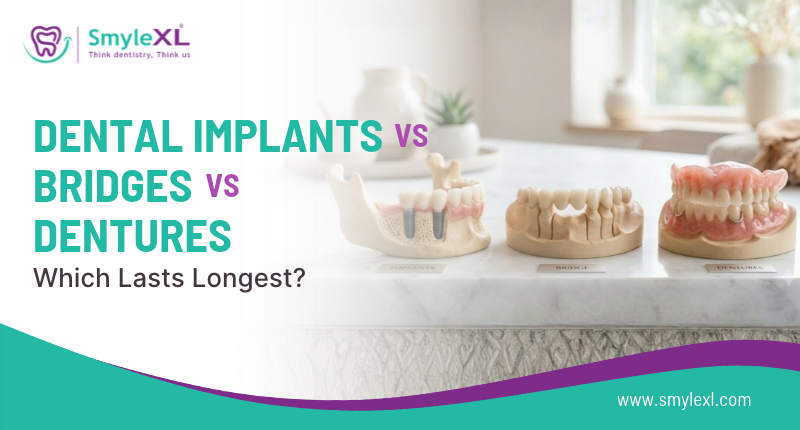

Losing a tooth can raise a bigger question than how to fill the gap: how long will the replacement last? If you are comparing dental implants, bridges, and dentures, longevity is an important part of the decision. However, the right choice also depends on how many teeth are missing, the condition of your gums and jawbone, your bite, and the health of the surrounding teeth.
At SmyleXL Dental Clinic, we help patients understand their dental restoration options based on their individual oral health rather than choosing a replacement. So, when comparing a dental implant treatment vs. bridges vs. dentures, what should you know about long-term results?
Table of Contents
ToggleWhich Lasts Longer: Implants, Bridges or Dentures?
In general, dental implants can provide a highly durable, long-term solution when they are properly planned, placed, and maintained. Long-term research has reported favorable implant survival, including a 2026 systematic review that estimated 93% implant survival at 20 years in the prospective studies it analyzed.
However, this does not mean every implant will last for the same number of years. Gum health, bone condition, oral hygiene, smoking, biting forces, and regular professional maintenance can influence dental implant lifespan.
Bridges and dentures can also serve patients successfully for many years. A systematic review of complete dentures found a weighted mean longevity of around 10 years, although individual results varied considerably.
How Does Dental Implant Treatment Compare With a Bridge?
A dental implant replaces the missing tooth with an implant placed in the jawbone, followed by a restoration such as a crown. A conventional bridge, on the other hand, fills the gap using support from neighboring teeth.
This distinction matters when you have a single missing tooth.
With dental implant treatment, the neighboring teeth generally do not need to serve as bridge supports. With a conventional bridge, the adjacent teeth support the restoration, so their condition matters when planning treatment.
Another difference is long-term maintenance. Both options require good oral hygiene and professional dental care, but they have different cleaning requirements and potential complications.
For a patient with a healthy mouth and suitable bone support, dental implant treatment may offer a durable fixed replacement without relying on adjacent natural teeth. However, a bridge can still be an appropriate solution in selected situations.
What About Dental Implants Compared With Dentures?
The comparison changes when you have multiple missing teeth or extensive tooth loss.
Dentures are removable appliances that can replace several missing teeth or an entire arch. They can be used for partial tooth loss as partial dentures or for complete tooth loss as complete dentures.
Implants can also be used in more extensive cases. Depending on the patient’s needs, they may support individual crowns, bridges, or implant-supported dentures.
This means dental implant vs dentures is not always a simple either-or decision. In some cases, implants and dentures can actually work together.
Implant-supported dentures can provide additional support and retention compared with conventional removable dentures. Implant-supported removable prostheses can be a viable option in selected cases, although long-term outcomes depend on the specific treatment design and patient factors.
What Factors Affect Dental Implant Lifespan?
Dental implant longevity depends on much more than the implant itself.
- Jawbone condition
An implant needs suitable bone support. Bone quantity and quality are therefore important considerations during treatment planning. Jawbone preservation is also important after tooth loss because the area around a missing tooth can change over time.
- Gum health
Healthy gums help provide a favorable environment around an implant. At SmyleXL, we assess and manage existing gum disease as part of comprehensive treatment planning.
- Oral hygiene
Daily brushing, appropriate interdental cleaning and professional dental check-ups can help protect the implant and surrounding tissues.
- Bite and chewing forces
Your bite also matters. Excessive or uneven forces can add stress to teeth and restorations. This is why the dentist needs to assess how your teeth meet before finalizing a restoration.
- Regular maintenance
Even a successful implant restoration isn’t maintenance-free. Regular examinations allow the dentist to monitor the implant, gums, surrounding bone, and restoration.
How Do Bridges and Dentures Compare for Longevity?
When looking at bridges vs dentures, remember that they are designed differently and are used for different clinical situations.
A dental bridge is fixed in place and can restore chewing function without requiring a removable appliance. Its longevity can depend on the supporting teeth, oral hygiene, bite, and the condition of the restoration.
Dentures are removable and may require adjustments or replacement as the mouth changes over time. Changes in the supporting tissues can affect how comfortably a denture fits.
For this reason, the question of bridges vs dentures should be answered after considering the number of teeth missing, the health of the remaining teeth, and the patient’s functional needs.
What Is the Right Option for a Missing Tooth?
No single replacement is ideal for every patient.
For a missing tooth, your dentist may consider an implant, bridge, or another restoration depending on the surrounding teeth and bone.
For multiple missing teeth, several approaches may be considered, including bridges, implants or implant-supported prostheses.
For complete tooth loss, complete dentures and implant-supported solutions may both be considered depending on bone availability, overall oral health, expectations, and treatment goals.
This is why dental restoration options should be evaluated individually rather than selected based only on lifespan.
At SmyleXL Dental Clinic dental implant treatment begins with an assessment of your teeth, gums, bone support, and bite. This helps determine whether an implant, bridge, denture or an implant-supported restoration is appropriate for your particular situation.
Which Option Should You Choose?
If your priority is long-term tooth replacement, dental implant treatment can be an important option to discuss with your dentist. Its potential longevity, fixed nature, and ability to replace a missing tooth without using neighboring teeth as conventional bridge supports make it different from bridges and dentures.
At the same time, bridges and dentures remain useful dental restoration options for many patients. The right choice depends on your oral health, treatment needs, number of missing teeth, bone condition, and personal preferences.
The most useful comparison is therefore not simply dental implant vs bridges, dental implant vs dentures, or bridges vs dentures. It is about finding a restoration that functions reliably and remains maintainable for your individual needs.
Frequently Asked Questions
How long can dental implants last?
Dental implant lifespan varies by patient. With appropriate planning, good oral hygiene, and regular maintenance, implants can provide long-term service.
Can a dental bridge last as long as an implant?
Both can provide durable tooth replacement, but their longevity depends on different factors. A bridge relies on its supporting teeth or implants, while an implant is anchored in the jawbone. The aftercare for both options matters for their longevity.
Do dentures need to be replaced?
They may. Dentures can change in fit and function as the mouth and supporting tissues change. The longevity of complete dentures varies, with age-related failure increasing over time.
Is dental implant treatment suitable for everyone?
Not necessarily. Before treatment, you need to evaluate bone availability, gum health, overall oral health, bite, and other individual factors.
What should I choose for multiple missing teeth?
There is no universal answer. Depending on your condition, options may include individual implants, implant-supported bridges, conventional bridges, partial dentures, or implant-supported dentures. A personalized evaluation at SmyleXL Dental Clinic can help identify the appropriate approach.
How many days should I rest after a tooth implant?
Prioritize rest for the first 24 to 48 hours after your tooth implant procedure. During this initial recovery period, give your body ample time to heal. After this time, continue to take it easy for an additional 2 to 3 days before gradually reintroducing light daily activities. This approach will help ensure a smoother recovery and better overall results.
Is dental implant minor or major surgery?
Dental implant placement is typically regarded as a minor oral surgical procedure, rather than a major surgical operation. It involves carefully inserting a titanium post into the jawbone to serve as a sturdy foundation for a replacement tooth. The procedure is usually performed under local anesthesia, making it a less invasive option for patients seeking solutions for missing teeth.
What are the possible complications of dental implants?
Dental implants are a reliable and effective tooth replacement option with a high success rate. However, potential risks include infection from bacteria at the surgical site, which can complicate healing. Additionally, nerve damage can lead to temporary or permanent numbness or tingling. Patients should also be aware of possible sinus issues if implants in the upper jaw extend into the sinus cavities, which can cause discomfort. While dental implants offer significant benefits, it’s essential to understand these associated risks.

Dr. Earle Santosh Kumar
Periodontist & Implantologist
Dr. Earle Santosh Kumar is an MDS-qualified Periodontist and Implantologist with 10+ years of experience, serving patients at SmyleXL Dental Clinic in Dwaraka Nagar, Visakhapatnam. He completed his BDS from Saint Joseph Dental College, Eluru, in 2013 and MDS in Periodontics from Government Dental College & Hospital, Vijayawada, in 2017. His expertise includes periodontal care, dental implants and comprehensive gum and dental treatments, with a patient-focused approach to personalised care.
Professional Profile: Dr. Earle Santosh Kumar
Facebook: SmyleXL Facebook
Instagram: SmyleXL Instagram
YouTube: SmyleXL YouTube