
There is a very specific way people react to losing one tooth.
If multiple teeth are missing, people immediately think:
“Treatment karana padega.”
But with a single missing tooth, the brain starts negotiating.
“Side mein hai, zyada dikhta bhi nahi.”
“Ek tooth hi toh hai.”
“Dusre side se kha lenge.”
And slowly, life adjusts around the gap.
Until one day, something small happens.
That is usually the moment people begin seriously exploring dental implants.
At SmyleXL Dental Clinic, we often notice that patients consider replacing one missing tooth less urgent than replacing several. But interestingly, a single missing tooth can gradually affect chewing balance, jawbone support, and even nearby teeth more than people expect.
Table of Contents
ToggleEarlier, People Mostly Learned to Live With Missing Teeth
For many years, tooth loss automatically meant compromise.
Patients either ignored the space or chose bulky removable options that never fully felt natural. Treatment focused more on “filling the gap” than restoring normal function.
The problem was not only appearance.
When one tooth goes missing, the surrounding teeth slowly begin responding to that empty space. Teeth may tilt slightly. Opposing teeth may shift downward. Chewing pressure becomes uneven.
And underneath all this, another quiet change begins:
The jawbone slowly starts shrinking.
This happens because natural tooth roots stimulate the bone while chewing. Once the root disappears, the bone loses that stimulation too.
That is why modern restorative dental treatment focuses not only on replacing the visible tooth but also preserving the support underneath it.
Why Replacing One Missing Tooth Matters More Than People Think?
Patients often assume:
“It’s only one tooth.”
But the mouth rarely works tooth by tooth.
Everything functions as a system.
A single missing tooth can gradually affect:
- chewing comfort
- speech clarity
- bite balance
- jaw support
- nearby teeth alignment
At SmyleXL Dental Clinic, many patients initially visit for cosmetic concerns, but later realize that the functional issues matter even more.
Some struggle chewing comfortably on one side. Others notice food getting stuck repeatedly near the gap. Some develop sensitivity in neighboring teeth because those teeth slowly begin to carry extra pressure.
This is why missing tooth replacement is not only cosmetic. It also protects long-term oral stability.
The Most Common Options for Single Tooth Replacement Today
Modern dentistry usually offers three major solutions for replacing one missing tooth:
- dental implant
- dental bridge
Each option has advantages depending on the patient’s oral condition, budget, and long-term goals.
But over the years, one solution has changed single tooth replacement more dramatically than the others: the dental implant.
Dental Bridge: A Popular Option for Patients
Although dental implant treatment has become extremely popular, a bridge still remains a useful solution in certain cases.
A dental bridge works by placing crowns over the neighboring teeth and attaching an artificial tooth between them.
For patients who:
- cannot undergo surgery
- need faster treatment
- have limited bone support
- prefer non-surgical solutions
At SmyleXL Dental Clinic, we explain both advantages and limitations honestly.
A bridge can restore appearance and chewing function restoration successfully. But because it depends on neighboring teeth for support, those teeth may require reshaping even if they are healthy.
This is why treatment planning should always be personalized.
Why Dental Implants Changed Single Tooth Replacement Completely?
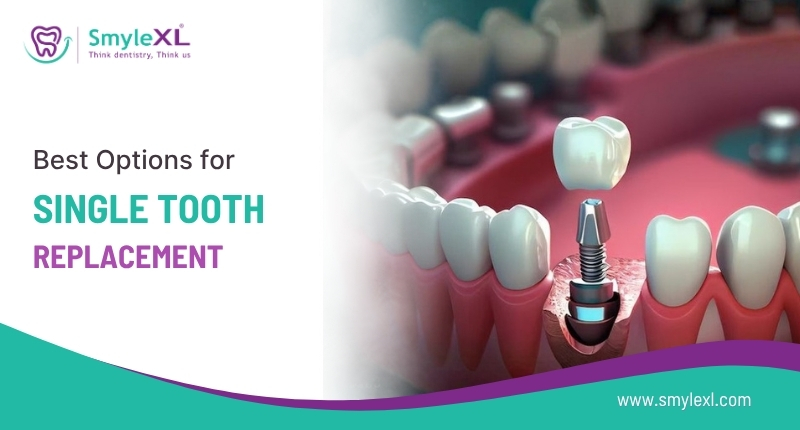
Instead of sitting above the gums alone, the implant replaces the missing root inside the jawbone too. A titanium dental implant is placed inside the bone, and over time, it bonds naturally with the surrounding jaw structure.
This process creates a stable foundation for the replacement tooth above it.
At SmyleXL Dental Clinic, patients are often surprised by how natural a single dental implant eventually feels.
Not because it looks artificial and impressive. But it slowly stops feeling noticeable at all.
Why Titanium?
Many patients become slightly nervous hearing the word “metal.”
But titanium became the gold standard for dental implant treatment because the human body usually accepts it remarkably well.
A titanium dental implant is highly biocompatible and resistant to corrosion. More importantly, the jawbone naturally bonds with titanium over time.
This creates stability that allows the implant to function almost like a natural root.
At SmyleXL Dental Clinic, patients often ask:
“Will it feel artificial?”
The interesting thing is:
Successful implants usually stop feeling like “treatment” after healing.
The Biggest Advantage of a Dental Implant
Unlike a dental bridge, a single dental implant does not usually require grinding down adjacent healthy teeth for support.
This helps with adjacent teeth protection, which is one of the major reasons implants became such a preferred long-term option.
The implant stands on its own.
That independence helps preserve:
- nearby teeth
- bite balance
- jawbone support
- chewing strength
And because the implant behaves similarly to a natural tooth root, it also supports jawbone loss prevention over time.
At SmyleXL Dental Clinic, this becomes especially important for patients who want permanent tooth replacement without compromising healthy surrounding teeth.
Replacing Missing Tooth Naturally Is About More Than Looks
Many people think replacing missing tooth naturally only refers to appearance.
But true natural replacement also means:
- comfortable chewing
- stable biting
- balanced speech
- healthy gum support
- confidence without overthinking
This is why chewing function restoration matters just as much as cosmetic improvement.
At SmyleXL Dental Clinic, we often remind patients:
The mouth notices function before the mirror notices aesthetics.
A replacement tooth should not only look natural in photographs.
It should feel natural while eating everyday foods, too.
A Missing Tooth Quietly Changes More Than People Realize
People adapt surprisingly well to missing teeth. That is why many delays happen. The mouth adjusts. The chewing shifts. The smile changes slightly. Life continues. Until eventually, the gap starts affecting more than appearance.
And that is usually when patients realize something important:
They were never really “used to it.”
At SmyleXL Dental Clinic, modern restorative dental treatment is not only about replacing teeth. It is about restoring balance, comfort, and confidence in a way that feels natural in everyday life. Visit us for more information on dental implant.
Frequently Asked Questions
Is an implant better than a dental bridge?
Dental implants are often preferred because they provide better adjacent teeth protection . Unlike bridges, which require healthy nearby teeth to be altered for support, implants stand alone, preserving the integrity of the surrounding dental structures. This makes them a more conservative option for tooth replacement.
How long does a dental implant last?
When combined with diligent oral hygiene practices and regular dental visits, an implant can last for many years, serving as a dependable, long-lasting solution for replacing missing teeth. This innovative treatment not only restores functionality and aesthetics but also improves overall oral health, making it an excellent choice for those seeking a permanent alternative to natural teeth.
Can dental implants help with bone loss?
Dental implants play a crucial role in preventing jawbone loss. They are designed to mimic the structure and function of natural tooth roots. By integrating with the jawbone, these implants provide essential stimulation during the chewing process. This stimulation helps maintain bone density and health, effectively counteracting the deterioration that can occur when teeth are missing.
Does a dental implant look natural?
Modern cosmetic tooth replacement focuses on creating dental implants that closely resemble natural teeth by matching their shape, shade, and alignment, ensuring a seamless and aesthetically pleasing integration with surrounding teeth. These implants are designed to perfectly match the shape, color, and alignment of existing teeth, ensuring they blend seamlessly into the smile. This attention to detail not only enhances visual appeal but also fosters a harmonious integration with the surrounding dental structures, providing patients with a confident and natural-looking solution to tooth loss.
Why should I replace a single missing tooth?
Delaying missing tooth replacement can affect chewing balance, nearby teeth alignment, and overall oral comfort over time. Ultimately, neglecting this dental concern can diminish your overall oral comfort, leading to potential discomfort and difficulty in everyday activities like eating and speaking.
How many 70-year-olds still have all their teeth?
Only a small percentage of older adults manage to maintain their complete set of natural teeth as they age. Specifically, about 20-25% of individuals aged 65-74 still have all their original teeth intact. This decline in dental health is often attributed to several factors, including the onset of gum disease, tooth decay, and the gradual wear and tear that occurs over the years.
What is the cost of a single tooth implant in Hyderabad?
A single tooth dental implant in Hyderabad typically costs between ₹25,000 and ₹60,000, while a complete implant with the abutment and crown can range from ₹35,000 to ₹80,000, depending on the implant brand, crown material, and whether additional procedures like bone grafting are needed.