
At some point, the idea of dentures sitting in a glass by the bedside stopped being just a cartoon trope and became a genuine concern. Nobody wants that. And the good news, the really good news, is that in most cases, nobody has to settle for it anymore.
Dentistry has moved well past the era where losing a tooth meant choosing between a gap and a removable plate. Today, dental implant treatment offers something that genuinely didn’t exist for previous generations: permanent, fixed teeth that feel, function, and look like the real thing. No removal at night, no adhesive in the morning, no quiet anxiety about whether they’ll stay put at dinner.
Whether you’re missing one tooth or considering a full-arch solution, the options available today are worth understanding properly, because the difference between what most people imagine and what’s actually possible is significant. Here’s the full picture.
Table of Contents
ToggleWhy Dentures Aren’t the Only Answer Anymore
Traditional removable dentures are a missing tooth solution that fills the gap visually. But they don’t solve the structural problem. Without a tooth root stimulating the jawbone, bone loss continues underneath. Over time, the jaw changes shape, the denture fit worsens, and the cycle of relining and replacing begins.
Dental implant treatment addresses the problem at the root level, literally. A titanium post replaces the missing root, the bone fuses around it, and what sits on top looks and functions like a natural tooth. No bone loss, no shifting, no nightly removal.
How Dental Implant Treatment Actually Works
The process behind the teeth implant procedure has a few key stages:
The Titanium Implant Post
A titanium implant post is surgically placed into the jawbone at the site of the missing tooth. Titanium is used because of its biocompatibility; the bone accepts it and grows around it rather than rejecting it.
Osseointegration
The osseointegration process is the healing phase where the jawbone fuses directly to the titanium implant post, typically over 3–6 months. This is what gives implants their stability. Once complete, the implant is as firmly anchored as a natural tooth root.
Dental Crown Placement
Once osseointegration is confirmed, dental crown placement completes the restoration. A custom-made crown, matched to the color and shape of surrounding teeth, is attached to the implant, completing the natural-looking smile.
Tooth Replacement Options: Which One Fits Your Situation?
Not every missing tooth solution looks the same, and the right option depends on how many teeth are missing, where they are, and what the jawbone situation looks like. Here’s how the main implant-based tooth replacement options break down:
Single Tooth Implant
The most straightforward form of dental implant treatment: one missing tooth, one implant, one crown. Here’s what makes it the gold standard for single replacing missing teeth:
- No adjacent teeth are affected or ground down
- Fits into the mouth as if it were always there
- Fully independent, no reliance on surrounding teeth for support
- The closest thing to replacing a tooth exactly as nature intended
Implant-Supported Bridge
For two or three consecutive missing teeth, an implant-supported bridge uses implants at either end to support a fixed teeth replacement in between, without involving natural teeth as anchors:
- No healthy tooth structure is removed on either side
- Stable, permanent, and non-removable
- A meaningful upgrade over traditional bridges for patients with healthy adjacent teeth
- Looks and functions like natural teeth once healed
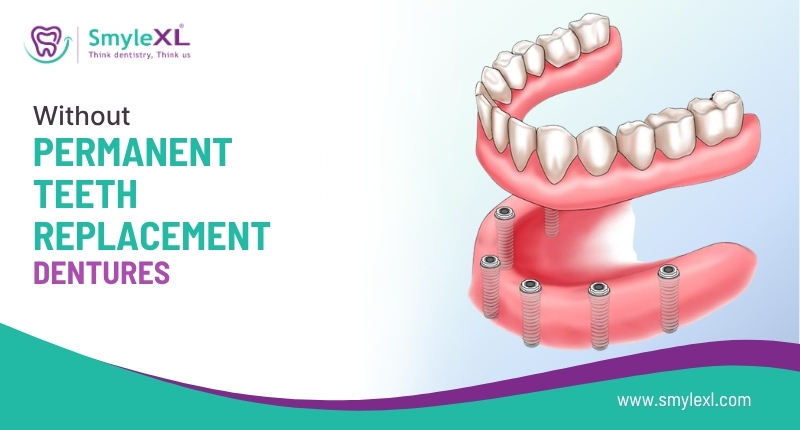
All-on-4 / All-on-6
Full arch permanent tooth restoration using just four or six strategically placed implants to support a complete set of fixed teeth, the option that most directly replaces traditional full dentures:
- Fixed in place; no removal, no adhesive, no movement
- Restorative dental care at a scale that restores full chewing function
- Eating, speaking, and smiling without a second thought becomes normal again
- Life-changing for patients who’ve spent years managing with removable options
The Real Benefits Beyond Aesthetics
Dental implant treatment does more than fill a gap. Here’s what’s happening beneath the surface:
| Benefit | What It Means |
| Prevention of bone loss | The implant stimulates the jawbone the way a natural root does, halting the resorption that follows tooth loss |
| Long-term oral health | Adjacent teeth remain untouched and healthy |
| Natural-looking smile | Crown matched to existing teeth, indistinguishable in most cases |
| Gum tissue healing | Proper implant placement supports a healthy gum contour around the restoration |
| Post-surgery recovery | Manageable and typically faster than most patients expect |
Prevention of bone loss is the benefit most patients don’t think about until they understand what happens without it. Bone resorption after tooth loss is gradual, progressive, and affects facial structure over time. Implants are the only tooth replacement options that stop it entirely.
Are You a Candidate?
Most adults with good general health are candidates for dental implant treatment. The main clinical considerations are:
- Jawbone density: Sufficient bone must exist to anchor the artificial tooth root. If significant bone loss has already occurred, bone grafting may be needed first
- Gum health: Active gum disease is treated before implant placement
- Smoking: Significantly increases failure risk and slows gum tissue healing; patients are strongly advised to stop before and after surgery
- Overall health: Uncontrolled diabetes and certain medications affect the osseointegration process outcomes and are discussed during assessment
Age is not a barrier; the teeth implant procedure is successfully completed in patients well into their 70s and beyond, provided there is bone and health support for it.
What Does Dental Implant Treatment Cost in Pimple Nilakh?
At SmyleXL Dental Clinic in Pimple Nilakh, Pune, here’s what dental implant treatment typically costs:
| Treatment | Approximate Cost |
| Single tooth implant | ₹15,000 – ₹30,000 |
| Implant-supported bridge | ₹60,000 – ₹2,00,000 |
| Full-mouth restoration (All-on-4/All-on-6) per jaw | ₹1,50,000 – ₹3,50,000 |
The range reflects the number of implants, whether bone grafting is needed, and the type of restoration placed. A detailed assessment at SmyleXL Dental Clinic gives you an exact, itemized figure before any treatment begins.
Restorative dental care can also be phased, spreading the investment across time while following a coordinated plan.orth discussing at the consultation.
The Permanent Solution That Actually Lives Up to the Name
Dental implant treatment is one of the only tooth replacement options that replaces both the root and the crown, addressing the problem completely rather than managing it. Artificial tooth root, osseointegration process, dental crown placement: the full sequence results in long-term oral health outcomes that removable options simply can’t match.
At SmyleXL Dental Clinic in Pimple Nilakh, every permanent tooth restoration starts with a thorough assessment, understanding exactly what’s needed, and presenting a clear plan before any decisions are made.
Book your consultation at SmyleXL Dental Clinic today, and find out what permanent actually feels like.
Frequently Asked Questions
How painful is a dental implant?
The teeth implant procedure is performed under local anesthesia, with no pain during surgery, just pressure. Post-surgery recovery involves mild soreness and swelling for 3–5 days, managed with prescribed medication. Most patients find it more comfortable than expected, comparable to a tooth extraction. The osseointegration process that follows is largely painless.
How long do dental implants last?
The titanium implant post can last a lifetime with proper care. The dental crown placement on top typically lasts 10–15 years before normal wear may require replacement. Long-term oral health outcomes for implants consistently outperform other tooth replacement options.
Do implants feel like real teeth?
Yes, once the osseointegration process is complete and dental crown placement is done, most patients report that implants feel completely natural. Biting force, sensation, and appearance are all close to a natural-looking smile. Most patients forget the implant is there within a few weeks of the final restoration.
What is the recovery time for a dental implant?
Post-surgery recovery happens within 1–2 weeks. The longer phase is the osseointegration process, taking 3–6 months for the titanium implant post to fully fuse with the jawbone. A temporary crown is usually placed during this period, so replacing missing teeth visually isn’t an issue while healing occurs.
Do you brush dental implants like regular teeth?
Yes, dental implant treatment maintenance is straightforward. Brush twice daily, floss around the implant, and attend regular check-ups. The artificial tooth root and crown don’t decay, but gum tissue healing and long-term gum health around the implant still require consistent care. Long-term oral health around implants depends on the same habits that protect natural teeth.