
Interceptive orthodontics is early treatment that starts while your child still has some baby teeth. It guides jaw growth and corrects bite problems before they become harder to fix. The ideal orthodontic check-up age is around 7, or sooner if you notice a problem. SmyleXL Dental Clinic offers this care for children, along with braces treatment in Vanasthalipuram for older kids, teens, and adults.
As a parent, you may wonder if your child needs braces now, later, or ever. Keep reading so you know what to look for and when to act.
Table of Contents
ToggleWhat Is Interceptive Orthodontics?
To “intercept” simply means to step in early. So, interceptive orthodontics means catching a bite problem while it is still developing. Instead of waiting for every permanent tooth to arrive, the dentist watches your child’s growth and acts at the right time.
Between roughly ages 6 and 10, children have what dentists call mixed dentition. This simply means baby teeth and permanent teeth are both in the mouth. It is a useful stage. The jaws are still growing, so they respond well to gentle guidance.
How is this different from braces treatment? Braces move teeth that have already come in. They usually begin once most permanent teeth are present, often between ages 11 and 14. Interceptive treatment works earlier and does a different job. It shapes the jaw and makes room for teeth that have not yet erupted. Think of it as preparing the ground before building a house.
Some children who have early treatment still need braces later. But that second stage is often shorter and simpler. Others need no braces at all.
Why Is Early Treatment Important?
A child’s jaws keep growing through childhood and the early teens. Once that growth slows, some problems need more complex methods to correct. Here is what early orthodontic treatment can do.
- It guides jaw growth. If the upper jaw is too narrow or the lower jaw grows out of balance, the dentist can steer it while the bones are still flexible. This is bite correction at its earliest stage.
- It makes space for permanent teeth. When baby teeth fall out too early, or the jaw is small, adult teeth can come in crowded or crooked. Early care can make room for them.
- It can help simplify future orthodontic treatment. A child with early guidance may need a shorter course of braces for children later. We say “may” because every child grows differently.
- It may reduce the chance of extractions. Treating crowding early can sometimes avoid the need to remove permanent teeth later. This is not a promise. Our dentist will be honest with you after examining your child.
- It protects teeth and builds confidence. Upper front teeth that stick out are more likely to chip in a fall. And children who feel shy about their smile often open up once their teeth look and feel better.
Local families searching for orthodontic treatment for kids often ask why we recommend starting this early. The reason is timing. During the mixed dentition stage, small changes made at the right moment can prevent bigger work later. That is the heart of bite correction in children.
Signs Your Child May Need an Early Check-Up
You do not need to be an expert. Watch for these signs at home:
- Baby teeth fall out very early or very late
- Crowded or crooked teeth coming in
- Difficulty biting or chewing food
- Upper front teeth that stick out, or lower teeth sitting ahead of the upper ones
- Teeth that do not meet properly when the mouth is closed
- A jaw that shifts or clicks when opening
- Mouth breathing or snoring at night
- A thumb sucking habit that continues past age 4 or 5
If you notice even one of these, get an orthodontic consultation. An early look often gives clear answers, and sometimes the answer is simply “come back in a year.”
Common Problems Addressed With Interceptive Orthodontics
- Jaw growth imbalance: The upper and lower jaws may grow at different rates or develop unevenly. Early orthodontic treatment can help guide jaw growth and improve their relationship.
- Crossbite: Upper teeth bite inside the lower teeth. This can make the jaw shift to one side.
- Crowded or crooked teeth: The jaw is too small for the teeth, so they overlap or twist.
- Underbite: The lower teeth sit in front of the upper teeth. Early guidance may help balance jaw growth.
- Protruding teeth: The upper front teeth stick out. They are easier to injure and can affect confidence.
- Thumb sucking habit: Long-term sucking can push front teeth forward and narrow the upper jaw.
- Malocclusion: This is the medical word for a bad bite, where upper and lower teeth do not fit together well. Crossbite, underbite, and crowding are all types of malocclusion.
Not every one of these needs treatment right away. Your dentist will check how severe it is and how fast your child is growing. But it is better to get it checked to avoid braces in adulthood. Even at 40, you want to get your teeth aligned; look no further than SmyleXL for braces treatment in Vanasthalipuram.
Types of Early Treatment
Early treatment does not always mean braces. Here are the common options we use at SmyleXL Dental Clinic before beginning braces treatment in Vanasthalipuram:
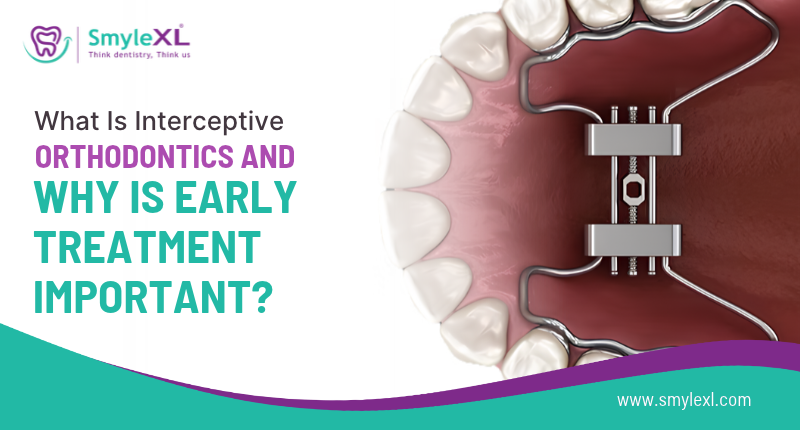
- Palatal expander: A small device that sits on the roof of the mouth. It slowly widens a narrow upper jaw, creating room for crowded teeth.
- Space maintainer: A small wire holder that keeps the gap open when a baby tooth is lost early. It stops nearby teeth from drifting in.
- Partial braces: Braces on just a few teeth, used to fix one specific problem such as a front tooth turned the wrong way.
- Habit appliances: A gentle device that helps a child stop thumb-sucking.
- Watchful monitoring: Sometimes the best treatment is regular check-ups. The dentist may also remove a baby tooth at the right time so the permanent tooth comes in better.
Most devices feel odd for the first few days. Children usually adjust quickly.
How Interceptive Orthodontics Differs From Traditional Treatment
Interceptive orthodontics focuses on identifying and correcting dental and jaw development problems while a child is still growing. It uses early treatments to guide jaw growth, create space for permanent teeth, and correct bite issues.
Traditional orthodontic treatment usually begins when most permanent teeth have erupted. It mainly focuses on aligning teeth, correcting bite problems, and improving overall smile alignment.
The key difference is that interceptive orthodontics guides dental and jaw development early, while traditional orthodontics mainly corrects existing alignment problems.
Age-Wise Timeline
The right orthodontic check-up age is not the same as the right treatment age. This table shows how orthodontic treatment for kids usually works.
| Age | What usually happens |
| 6–7 years | First check-up. The dentist looks at the bite, jaw, and erupting teeth. |
| 8–10 years | Common window for palatal expander, space maintainers, and habit correction. |
| 11–14 years | Most permanent teeth are in. Braces usually start here, if needed. |
| Later teens and adults | Braces or aligners align the teeth. Jaw growth is mostly complete, so treatment can take longer. |
Frequently Asked Questions
At what age should a child see an orthodontist?
By the age of 7, or even sooner if you notice any potential issues, it’s important to take your child for a dental check-up. At this stage, many permanent teeth have already emerged, allowing the dentist to assess the development and alignment of both the teeth and the jaws. This early evaluation is crucial for identifying dental problems and supporting the proper growth and health of your child’s smile.
Can children get braces with baby teeth?
Orthodontists sometimes use partial braces to address specific dental issues while baby teeth are still present. In contrast, full braces are generally recommended once most permanent teeth have emerged, enabling a more effective alignment of the overall dental structure.
Does every child need early orthodontic treatment?
Many children require only consistent monitoring to ensure their well-being. Early intervention is crucial for addressing issues that can worsen or become more challenging to manage over time.
How long does early treatment take?
The timeline for treatment varies significantly depending on the specific issue. In some situations, resolving the problem may take just a few months, while others could take a year or longer. After a thorough examination of your child’s dental condition, our dentist can provide a more accurate estimate of how long braces treatment in Vanasthalipuram will likely take.
What happens if crooked teeth are left untreated in children?
Some mild cases only need monitoring. Others can lead to crowding, uneven wear, jaw problems, or difficulty cleaning teeth. An exam shows which case your child has.
Early Care Is About Timing
Interceptive orthodontics focuses on identifying and correcting dental and jaw development problems while your child is still growing.
If your child is around 6–7 years old or you have noticed signs such as crowded teeth, crossbite, protruding teeth, or uneven jaw growth, it may be a good time to book an orthodontic check-up at SmyleXL Dental Clinic.
Whether you need braces treatment in Vanasthalipuram now or an early orthodontic assessment, we will examine your child’s teeth and jaw, explain our findings in simple words, and guide you on whether treatment is needed now, later, or not at all.

Dr. Baswalingam
Orthodontist & Smile Designing Specialist
Dr. Baswalingam is an MDS-qualified orthodontist with 14+ years of experience, serving patients at SmyleXL Dental Clinic in Vanasthalipuram, Hyderabad. His areas of expertise include orthodontics, smile designing, dental implants and Invisalign treatment. He follows a systematic, patient-focused approach and stays updated with modern advancements in dentistry to provide personalised dental care.
Professional Profile: Dr.Baswalingam
Facebook: SmyleXL Facebook
Instagram: SmyleXL Instagram
YouTube: SmyleXL YouTube