
Most patients who come in for a dental implant consultation have done their research. They know what osseointegration means. They’ve looked up titanium posts and crown materials. They’ve compared All-on-4 to conventional implants and have a rough sense of the costs involved.
Very few of them have heard of the 3-2 rule.
And yet, the 3-2 rule is one of the most clinically significant guidelines in implant dentistry. It directly influences whether your implant is placed in a position that supports long-term success or one that quietly sets it up for complications years down the line. It’s the kind of detail that separates a meticulously planned implant from one that was placed in a hurry.
At SmyleXL Dental Clinic, we believe patients deserve to understand the principles behind dental implant treatment in Kondhwa, not just the procedure itself. So here is the 3-2 rule, explained clearly and completely.
Table of Contents
ToggleWhat the 3-2 Rule Actually Means
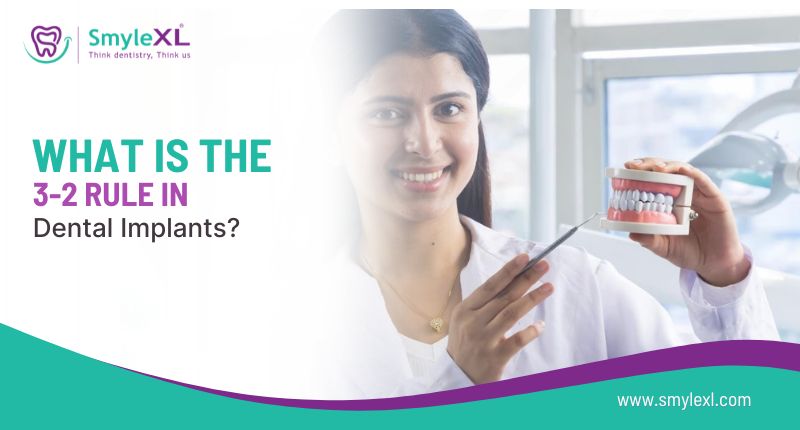
The 3-2 rule is a spacing guideline used in implant planning to determine the minimum safe distances between implants and surrounding structures.
It states two things:
3 millimetres must be maintained between a dental implant and any adjacent natural tooth.
2 millimetres must be maintained between one dental implant and another implant placed beside it.
That’s it. Two numbers. But the implications of respecting or violating those numbers are significant enough that every experienced implant dentist plans around them before placing a single implant.
Why 3mm from a Natural Tooth?
When an implant is placed too close to a neighbouring natural tooth, several problems can develop, none immediately visible, all progressive.
The most significant is bone loss. The area between an implant and a natural tooth is a zone of concentrated biological activity. If the gap is insufficient, less than the recommended 3mm, the bone in that narrow space cannot maintain an adequate blood supply. Over time, it begins to resorb, pulling away from both the implant and the natural tooth root. The implant loses structural support. The neighbouring tooth loses its bony foundation. What began as a spacing shortcut ends as two compromised structures instead of one successful restoration.
There is also the matter of the biological width, the collar of soft tissue that forms around both natural teeth and implants, creating a protective seal against bacteria. A gap smaller than 3mm doesn’t provide enough physical space for both biological widths to exist independently. They encroach on each other, the tissue becomes chronically irritated, and the seal that protects the underlying bone is compromised.
For patients seeking dental implant treatment in Kondhwa at SmyleXL Dental Clinic, our planning phase involves precise digital measurements rather than visual estimation. The difference between 2.8mm and 3mm is invisible to the naked eye and catastrophic in its long-term implications.
Why 2mm Between Two Implants?
The reasoning here follows similar logic, but with one additional factor that makes the implant-to-implant gap a distinct concern.
Two implants placed side by side without adequate spacing compete for the same bone. The crestal bone, the ridge of bone at the top of the jaw between two closely placed implants, is vulnerable to resorption simply because it sits in a zone of competing mechanical forces and limited vascular supply. When this crestal bone resorbs, the implants lose the bone support that keeps them stable, and the papilla, the small triangle of gum tissue between the implants, collapses. This creates an aesthetic problem in the visible smile zone and a hygiene problem everywhere else.
Two millimetres between implants maintains enough bone width to support independent biological activity around each implant. The blood supply is preserved. The crestal bone remains stable. The papilla stays healthy. The implants function as two independent restorations rather than two structures fighting over the same limited biological real estate.
Where the 3-2 Rule Gets Complicated
In a perfect clinical world, every patient presents with abundant bone, ideal spacing, and jaw anatomy that accommodates the 3-2 rule without any compromise. In practice, things are more nuanced, and this is where implant planning becomes a genuine clinical skill rather than a mechanical process.
Narrow arches and small jaws can make 3-2 compliant spacing genuinely challenging. When the available bone is limited in width, or when multiple adjacent teeth are missing, and the gap to be restored is smaller than ideal, the implant diameter, position, and restoration design must be considered together to achieve safe spacing without compromising the aesthetic or functional outcome.
Multiple missing teeth present a more complex planning puzzle. Replacing three adjacent missing teeth, for example, requires calculating the spacing between each implant, the spacing from each end implant to the neighbouring natural teeth, and whether the available bone width physically accommodates all of this within the 3-2 guideline. Sometimes the answer involves fewer implants than teeth — using bridge restorations supported by strategically placed implants rather than an implant for every missing tooth.
Bone grafting may be necessary due to the 3-2 rule. If the available bone is too narrow in width to allow 3mm clearance from adjacent teeth without placing the implant in a structurally compromised position, augmenting the bone first creates the physical space the rule requires.
At SmyleXL Dental Clinic, dental implant treatment in Kondhwa always begins with a thorough assessment of your bone dimensions, as this planning determines whether grafting is needed before a single implant is placed.
How Violating the 3-2 Rule Manifests Over Time?
This is the section that matters most for patients trying to understand why this rule deserves their attention, because the consequences of ignoring it don’t appear immediately. They arrive gradually, often years after placement, in ways that feel unrelated to the original procedure.
Persistent gum inflammation around an implant that otherwise seems intact. Gradual bone loss is visible on follow-up X-rays. A neighbouring natural tooth is developing unexplained sensitivity or mobility. The papilla between two implants is disappearing, leaving a dark triangular gap in the smile line. Crestal bone resorption that eventually compromises the implant’s stability and requires intervention.
None of these are inevitable outcome of implant treatment. They are outcomes of inadequate planning. And in many cases, they trace directly back to a spacing violation that could have been avoided with a 3D scan, careful measurement, and a dentist who understands why these two numbers matter.
What Proper 3-2 Implant Planning Looks Like at SmyleXL Dental Clinic?
Implant planning at SmyleXL Dental Clinic begins with a CBCT scan, a three-dimensional image of your jaw that shows bone height, width, and density at every point relevant to your treatment. This is not optional or an upsell. It is the baseline requirement for safely and predictably placing implants.
From the scan, a digital treatment plan is developed that maps the precise position, angle, and depth of each implant, confirming 3-2 rule compliance before the surgical appointment is even scheduled. If the available bone doesn’t allow for ideal positioning, the conversation about grafting or alternative approaches happens at the planning stage, not after the fact.
The result is implants that are not just placed, but placed correctly. Positioned within the biological framework that gives them the best possible chance of functioning without complication for decades.
This is what good dental implant treatment looks like. Not the fastest path to a crown, but the most carefully considered one.
The Number You Should Remember Walking Away From This
The 3-2 rule is two numbers, but it stands for one principle: that dental implant success is not just about the implant itself. It is about where the implant lives, its relationship to the adjacent teeth, the surrounding bone, and the biological environment it needs to integrate into and function within.
Patients who understand this are better equipped to ask the right questions at their consultation. Was a 3D scan used for planning? What is the spacing between my implant and the adjacent tooth? Are the distances 3-2 compliant? These are not overly technical questions. They are the questions of a patient who understands that the details in implant dentistry are not details at all; they are the difference between a restoration that lasts twenty years and one that requires revision in five.
At SmyleXL Dental Clinic, every Dental Implant Treatment in Kondhwa is planned with these principles at its foundation. Because the patients who trust us with their smiles deserve nothing less than treatment that is built to last.